.png?width=150&height=66&name=logo_ae_tech_2-(1).png "AE Technology Solutions Logo")
.png?width=200&height=66&name=logo_ae_tech_2-(1).png "AE Technology Solutions Logo")



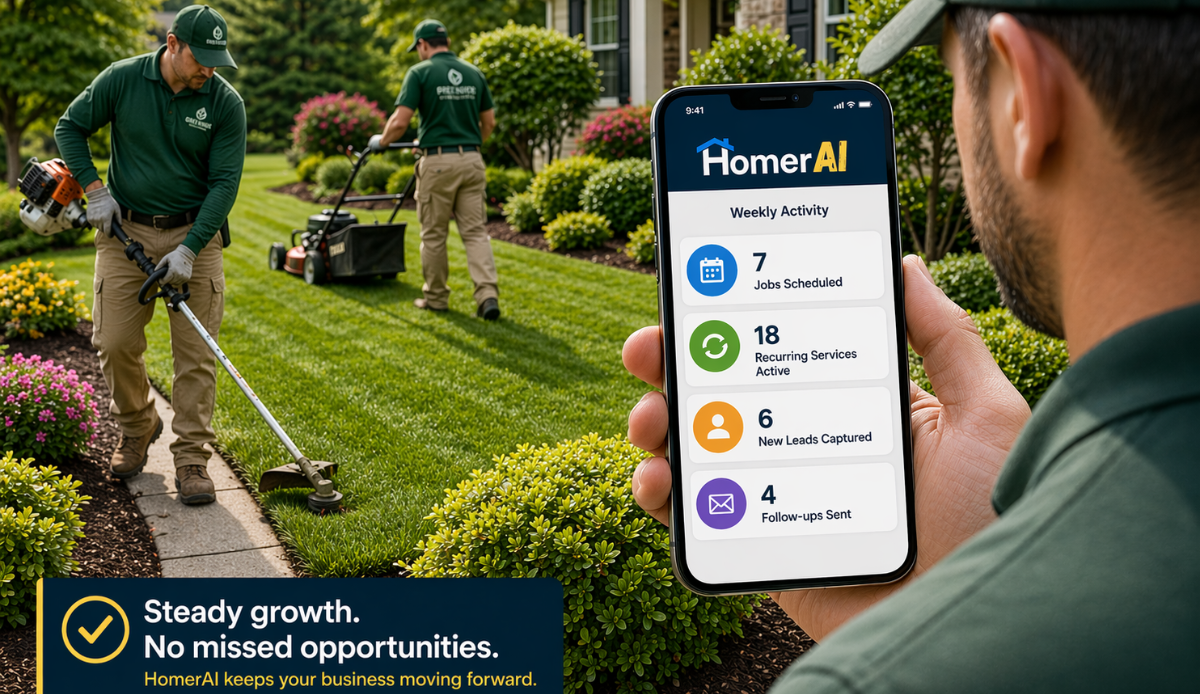
The landscaping business has a seasonality problem that most owners have learned to live with rather than solve. Spring arrives, the phone goes crazy, the crew is stretched thin, leads pile up faster than you can call them back, and somewhere in the chaos a portion of that demand quietly slips to a competitor who answered faster. Then summer settles in, recurring clients are running smoothly, and the team finds its rhythm. By fall, the cycle starts again with cleanup season and winter prep, and the feast-or-famine dynamic reasserts itself in a different form.
What if the intake side of your landscaping business never had a slow response, regardless of the season or the hour? AI agents are giving landscaping companies exactly that, a front-end operation that captures leads, books services, and manages follow-up automatically, so the business grows steadily rather than lurching between overwhelmed and underutilized. This article breaks down the ROI of AI assistance for landscaping businesses specifically, through five proof points: leads captured during seasonal demand peaks, recurring jobs booked without manual outreach, response time that outpaces the competition, admin hours reclaimed from scheduling and confirmation, and total revenue influenced by consistent automated processes.
The landscaping opportunity is not just about being more efficient during busy season. It is about building a business model that generates revenue continuously rather than reactively.
Capturing Leads at the Exact Moment Spring Demand Spikes
Landscaping lead volume is intensely seasonal and the timing of that surge is somewhat predictable, but the exact week it hits is not. When temperatures break and homeowners suddenly decide the yard needs attention, the demand can go from zero to overwhelming in a matter of days. Companies without a reliable intake system during that window lose a disproportionate share of their potential spring revenue to competitors who happened to pick up the phone.
The challenge is compounded by the fact that spring demand does not arrive conveniently during business hours. Homeowners thinking about their landscaping on a Sunday afternoon or browsing options on a Tuesday evening are ready to engage right then, not when your office opens. A conversational AI agent handles these inquiries immediately regardless of when they arrive, asking the right qualifying questions, gathering property details, and initiating the booking process before the homeowner moves on to the next search result.
For landscaping businesses, this 24/7 lead capture capability has an immediate impact on the number of spring contracts secured. Rather than working through a backlog of weekend voicemails Monday morning and finding that half the callers have already booked with someone else, every inquiry is engaged within seconds. Over the course of a three to four week spring rush, the difference in leads captured through immediate AI response versus next-business-day callbacks can represent a significant share of the season's recurring client base.
Recurring clients, once secured in spring, generate revenue through summer maintenance, fall cleanup, and often winter services as well. The value of a captured spring lead extends well beyond a single mow. It is a multi-season revenue relationship, which means every lead lost at intake during spring rush costs more than that first job alone.
Booking Recurring Services Without Manual Scheduling
The recurring maintenance model is the financial backbone of most successful landscaping companies. Weekly or bi-weekly lawn maintenance, monthly landscape maintenance visits, and seasonal service packages generate predictable revenue that smooths out the income volatility that one-time project work creates. But building and maintaining a recurring client base requires consistent scheduling management that is surprisingly time-consuming for a small operation.
AI agents automate the booking and schedule management for recurring services. When a new client inquiry comes in, the AI qualifies the lead, presents available maintenance packages, and books the recurring service onto the schedule, including confirming the service frequency, preferred day range, and any specific property notes. Existing clients who want to add a service, adjust their schedule, or ask about seasonal upgrades can do so through the AI without the interaction requiring staff time.
The jobs booked through this kind of frictionless scheduling compound over time. The easier it is for a homeowner to add a service or commit to a recurring package, the higher the conversion rate on those inquiries. Landscaping companies that remove the friction of scheduling, by making it available around the clock and handling it automatically, consistently report higher close rates on recurring service inquiries than those that require a callback or email exchange to finalize a booking.
Seasonal service add-ons are another area where AI booking automation pays dividends. A current maintenance client who receives an automated message in September explaining fall cleanup packages and offering to add the service to their existing schedule converts at a much higher rate than a client who receives a generic end-of-season mailer. The AI handles outreach to your existing client base proactively, presenting the right service at the right time and making it easy to say yes.
Winning the Response Race Against Competitors in the Same Neighborhood
Landscaping markets are often intensely local. In a given neighborhood, three or four landscape companies may be actively competing for the same contracts, and homeowners frequently contact multiple companies before choosing one. In that environment, response time is a significant differentiator. The first company to respond with relevant information and an easy path to booking has a meaningful advantage over those that respond hours or days later.
AI agents eliminate response lag entirely. When a homeowner submits an inquiry at any hour, the AI responds within seconds, acknowledges their specific request, and moves immediately to qualifying and scheduling. By the time a competitor's office opens the next morning, your company has already confirmed the consultation or booked the first service visit.
This response time improvement compounds in neighborhoods where you are already working. One new client on a block generates visibility with neighbors, and when those neighbors inquire, being the first to respond reinforces the impression of an organized, professional operation. AI agents ensure that every inquiry, regardless of when it arrives, gets the same fast, competent initial response.
The impact is particularly visible during storm-related cleanup events, which in landscaping translate to downed tree removal, debris cleanup, and drainage work after heavy rainfall. Like the demand surge roofing companies experience, landscaping companies that respond immediately to cleanup inquiries win a disproportionate share of available work. AI agents provide that consistent responsiveness without requiring anyone to be available around the clock.
Recovering the Administrative Hours That Landscaping Season Consumes
Landscaping operations have a coordination overhead that is easy to underestimate. Client onboarding involves gathering property details, confirming service parameters, and setting scheduling preferences. Weekly route management requires communicating with clients about access, gate codes, and special requests. Seasonal transitions require outreach to the entire client list about changed schedules, new service offerings, and winterization planning. And through all of it, the phone keeps ringing with new inquiries from homeowners who need quotes.
AI agents absorb a large portion of this coordination load automatically. New client onboarding questionnaires, service confirmation messages, scheduling reminders, and responses to routine client questions are handled without staff intervention. When a client needs to report a gate code change or request that the crew skip a visit because they are having a party, the AI captures that information and routes it appropriately without requiring an office call.
For landscaping business owners operating without dedicated administrative staff, this shift is transformative. Many owner-operators spend two to three hours per day on scheduling coordination, client communication, and inquiry response during peak season. Recovering that time means being able to focus on crew management, quality control, and the business development activities that drive long-term growth, or simply reclaiming work-life balance during a season that can otherwise become all-consuming.
The admin hours saved also reduce the most common trigger for premature hiring in landscaping businesses. Many owners hire administrative help not because they have reached the scale that requires it but because the coordination demands of a 40 or 50 client route feel unmanageable without it. AI handles that coordination layer reliably, allowing the business to grow its client base significantly before the operational case for dedicated admin staff actually materializes.
Growing Client Count Season After Season Without Expanding Overhead
Landscaping business growth in the traditional model is resource-constrained at multiple levels simultaneously. Adding clients requires more crew capacity, more equipment, and more administrative support to manage scheduling and communication. Owners who want to grow carefully, building quality before quantity, often throttle their own marketing because they cannot handle the volume of new clients that strong marketing would generate.
AI agents remove one of those constraints entirely. The intake and scheduling capacity of your business becomes effectively unlimited from the front-end perspective. Whether ten homeowners or one hundred homeowners inquire in a week, the AI handles all of them with the same immediate, consistent response. Your constraint becomes crew capacity and equipment, which are real and manageable constraints, not the artificial bottleneck of an overwhelmed intake process.
This growth model also supports geographic expansion in a way that traditional operations cannot. When a landscaping company wants to extend into a new service area, the administrative burden of handling inquiries and onboarding clients in that new territory falls entirely on the AI. There is no need to hire a local coordinator or establish a satellite office presence. The AI agent covers intake across all service areas simultaneously, allowing the business to test and expand into new markets with minimal operational risk.
The long-term financial impact of growing client count without proportionally growing overhead is a steady improvement in profit margins. Revenue per crew member increases as administrative efficiency improves. Recurring client retention improves as follow-up and communication become more consistent. And the owner extracts more income from the same operational footprint because the AI is doing work that would otherwise require paid staff.
Conclusion
Landscaping businesses succeed by delivering reliable, quality service over time, but too many of them constrain their own growth by relying on manual intake and scheduling processes that cannot scale with demand. AI agents change the economics of growth fundamentally by handling the front-end of the business automatically, capturing every lead during seasonal surges, booking recurring services without friction, responding to inquiries faster than competitors, recovering hours of administrative overhead, and nurturing long-term client relationships through consistent automated follow-up.
The five ROI proof points tell a clear story: more leads captured during the windows that matter most, more recurring contracts booked because the process was simple and immediate, better first impressions through faster response, meaningful time returned to the owner and team, and steadily growing revenue that does not require proportional growth in staff or overhead. That is a better business model, and AI is what makes it possible.
Ready to Build a Landscaping Business That Grows Itself?
AE Technology Solutions builds AI agents designed for service businesses that compete on responsiveness, reliability, and customer experience. Our conversational AI chatbots and voicebots handle your intake, scheduling, and follow-up automatically so your landscaping business can take on more clients, retain them longer, and grow revenue without adding office headcount. Visit www.aetechnologysolutions.com to find out how.
Comments