.png?width=150&height=66&name=logo_ae_tech_2-(1).png "AE Technology Solutions Logo")
.png?width=200&height=66&name=logo_ae_tech_2-(1).png "AE Technology Solutions Logo")


Every home services business owner knows the feeling: the phone rings while your team is out on a job, the voicemail fills up over the weekend, and Monday morning starts with a pile of missed opportunities instead of confirmed bookings. Growth sounds great until you realize that growing usually means hiring, and hiring means more payroll, more management, and more risk. But what if your business could handle more volume, capture more leads, and book more jobs without adding a single person to your roster?
AI assistance is reshaping the way home services companies operate, and the ROI is no longer theoretical. From plumbing and HVAC to electrical contracting and residential cleaning, businesses across the industry are discovering that AI agents do not just save time, they directly influence revenue. This article walks through exactly how that works, focusing on five measurable proof points: leads captured, jobs booked, response time improvement, admin hours saved, and revenue influenced.
The good news is that you do not need to overhaul your entire operation to see results. AI agents are designed to integrate with the tools and workflows you already use, filling the gaps that cost you money every day without requiring your team to become tech experts. Here is what scalable, AI-powered growth actually looks like for a home services business.
Why Faster Response Time Means More Booked Jobs
Speed wins in home services. When a homeowner has a leaking pipe, a broken AC unit, or wiring that is sparking, they are not going to wait two hours for a callback. Research consistently shows that the probability of converting a lead drops dramatically after the first five minutes of no response. The businesses that answer first, even if that answer comes from an AI agent, are the businesses that get the job.
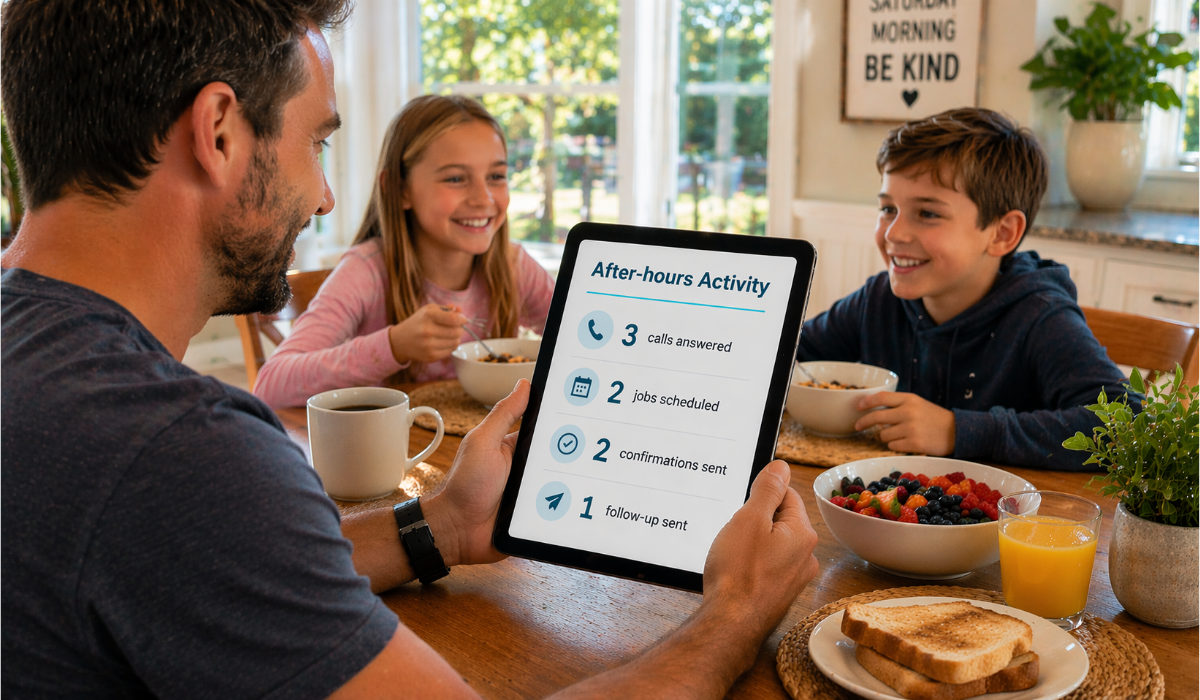
AI agents built for home services can answer inbound calls and web inquiries instantly, around the clock. A homeowner who fills out a contact form at 10 PM on a Sunday does not have to wait until Monday morning for a response. The AI agent acknowledges the request immediately, gathers the necessary information, and in many cases books a service appointment right then. By the time your crew starts their day, that job is already on the schedule.
This kind of response time improvement is not a minor convenience. It is a direct revenue driver. Every business that deploys an AI receptionist service starts treating after-hours contacts as confirmed opportunities rather than coin-flip maybes. The industry standard for call answer rates among small home services businesses hovers around 60 to 70 percent during business hours, which means a significant portion of calls are already going unanswered even when the office is open. AI coverage closes that gap completely, turning missed calls into booked jobs instead of lost revenue.
How 24/7 Lead Capture Changes Your Revenue Ceiling
Your revenue potential has historically been capped by your office hours. Leads that come in outside those hours either wait, go to a competitor, or simply disappear. For a business that relies on consistent project flow to fund growth, those losses add up faster than most owners realize.
Twenty-four-seven lead capture through conversational AI chatbots and voicebots removes that ceiling entirely. An AI agent does not clock out. It handles inquiries on evenings, weekends, and holidays with the same consistency as a well-trained front desk team member. It asks the right qualifying questions, captures contact information, identifies the nature of the service need, and initiates the booking process, all without human intervention.
Consider what this looks like in practice for an HVAC company heading into summer. As temperatures climb, homeowners start reaching out to schedule tune-ups and address system failures. Much of that demand happens outside traditional business hours because people notice their AC is struggling when they get home in the evening or when it fails on a Saturday. A company with AI-powered 24/7 coverage books those appointments as they come in. A company without it wakes up to voicemails and a full inbox that takes half the morning to sort through. Over an entire busy season, the difference in leads captured and jobs booked can represent a substantial share of annual revenue.
According to industry data from HVACR Global (https://hvacr-global.com/), the demand cycle for HVAC services is intensely seasonal and highly competitive. Businesses that capture leads at the moment of intent, rather than hours later, consistently outperform those relying on callback models. AI is now the most practical way to maintain that kind of responsiveness at scale.
What Admin Hours Saved Actually Means for Your Bottom Line
Labor costs are the largest line item for most home services businesses, and a disproportionate share of that labor is spent on administrative work that AI handles better and faster. Scheduling calls, appointment confirmations, follow-up messages, answering repeat questions about pricing and availability, collecting job details before dispatch — these tasks consume hours of staff time every week that could be directed toward higher-value work.
When you deploy AI agents to handle these functions, the savings compound quickly. A business fielding 80 to 100 inbound inquiries per week might spend 15 to 20 hours of staff time handling the administrative side of those contacts. With AI taking on intake, qualification, scheduling, and confirmation, that time drops significantly. Your team becomes available to focus on customer relationship management, complex problem-solving, and the quality control work that actually requires human judgment.
For smaller businesses without a dedicated office manager, this shift is even more impactful. Owners and field technicians routinely absorb administrative tasks themselves, pulling attention away from billable work. Every hour a technician spends returning calls or confirming appointments is an hour that is not generating revenue. AI agents eliminate that friction by handling the routine administrative load automatically, allowing your best people to stay focused on what they do best.
The downstream effect on hiring is equally important. Many businesses expand their administrative headcount reactively, adding staff because the call volume and scheduling demands feel unmanageable. AI agents absorb that volume without adding payroll, meaning you can grow your revenue without keeping pace on staffing costs. The operational leverage this creates is one of the clearest financial arguments for AI adoption in home services.
Automated Follow-Up: The Revenue You Are Leaving on the Table
Most home services businesses have a follow-up problem. A prospective customer inquires, gets an estimate, and then goes quiet. Without a reliable system for follow-up, that lead gets cold while your office moves on to the next urgent call. Industry research suggests that the majority of unconverted leads simply did not receive timely follow-up, not that they chose a competitor.
Automated follow-up through AI agents addresses this directly. When a lead completes an inquiry but does not book, the AI agent initiates a follow-up sequence via text or email, reminding the prospect of their inquiry, offering to answer questions, and making it easy to complete the booking. This happens automatically, on a schedule that maximizes the likelihood of re-engagement, without requiring your staff to manage a follow-up list.
For businesses offering seasonal services like gutter cleaning, HVAC maintenance, or exterior power washing, automated follow-up also enables proactive outreach to past customers at the right time of year. The AI agent can reach out to the previous year's customer list with a personalized message reminding them that it is time for their annual service, capturing repeat bookings that would otherwise require a manual campaign. This kind of systematic re-engagement turns your existing customer base into a reliable revenue stream without adding marketing overhead.
The revenue influenced by consistent follow-up is difficult to overstate. In competitive markets, the businesses that follow up reliably win a disproportionate share of the available work. AI makes that reliability automatic, removing the human inconsistency that causes so many solid leads to slip away.
Growing Revenue Without Growing Headcount
The traditional model of growth in home services is straightforward: more jobs require more people, more people require more management, and more management requires more oversight. That model works, but it is slow, expensive, and operationally complex. Hiring the right person takes time, training takes more time, and turnover undoes both.
AI agents offer a fundamentally different growth model. Rather than scaling headcount to match volume, you scale your AI coverage. The same AI receptionist service that handles 50 inbound contacts per week handles 200 without any additional cost or configuration. It does not get overwhelmed during peak season. It does not call in sick on a Friday before a long weekend. It performs consistently whether it is handling three calls or three hundred.
This shifts the growth equation in a way that directly benefits profitability. When revenue grows but overhead does not, margins expand. For a home services business operating on the relatively thin margins typical of the industry, that expansion has a meaningful impact on owner income, reinvestment capacity, and long-term stability. AI does not just help you grow, it helps you grow more profitably.
The no-hiring-required model is also a hedge against one of the most persistent challenges in the trades: the difficulty of finding and retaining qualified office staff. The labor market for administrative roles in home services is competitive, and high turnover in those positions disrupts customer experience and creates recurring training costs. AI agents eliminate that vulnerability entirely for the functions they cover, providing consistent, reliable performance without the staffing risk.
The Five ROI Proof Points in Practice
When home services businesses evaluate AI adoption, these five metrics consistently emerge as the measurable indicators of value:
-
Leads captured: AI agents with 24/7 availability increase the total number of inquiries that enter your pipeline rather than going unanswered.
-
Jobs booked: Faster response and streamlined scheduling convert a higher percentage of those leads into confirmed appointments.
-
Response time improvement: Immediate AI response, whether by phone, chat, or text, eliminates the lag that causes prospects to move on.
-
Admin hours saved: Automating intake, scheduling, and follow-up reclaims significant staff time that can be redirected to revenue-generating activity.
-
Revenue influenced: The combination of better lead capture, higher conversion, and systematic follow-up expands the total revenue attributable to your marketing and sales effort.
Comments