.png?width=150&height=66&name=logo_ae_tech_2-(1).png "AE Technology Solutions Logo")
.png?width=200&height=66&name=logo_ae_tech_2-(1).png "AE Technology Solutions Logo")


Pool installation and maintenance companies operate on a business model that combines high-value project work with recurring service relationships, and that combination creates a unique set of operational demands. During installation season, the business is managing multiple large projects simultaneously, each with its own timeline, material coordination, and client communication needs. During the maintenance seasons, the recurring service base requires consistent scheduling, chemical adjustments, equipment checks, and proactive customer communication to keep accounts healthy and prevent churn. The administrative thread running through both of these operational modes is substantial, and in most small to mid-size pool service companies, that thread is managed entirely by a small office team that is doing everything from answering inbound calls to coordinating service windows to chasing overdue invoices.
The growth ceiling this creates is real and predictable. As the business adds more installation projects or more recurring maintenance accounts, the admin load grows at roughly the same rate. The office team reaches capacity, response times slow, follow-up becomes inconsistent, and the customer experience degrades exactly when demand is highest. The instinctive response is to hire another admin person, but that hire adds fixed cost while solving a variable capacity problem. It also does not necessarily improve the quality of communication, because the bottleneck was never about having the wrong people. It was about having too much routine work running through too few hands.
Operational efficiency through AI agents breaks this pattern by separating the routine communication layer from the work that genuinely requires human expertise. When AI handles intake, scheduling, reminders, and routine follow-up, the human team applies its attention to relationship management, technical problem-solving, and the high-value interactions that drive loyalty, referrals, and revenue growth.
How Much Admin Work Does a Pool Service Company Generate Per Account Per Year?
A recurring maintenance account in a pool service business generates a predictable stream of administrative touchpoints throughout the year. Seasonal opening and closing scheduling, weekly or biweekly service confirmations, chemical treatment reminders, equipment issue follow-ups, and annual renewal outreach each represent distinct communication tasks that need to happen consistently for the account to remain active and satisfied. For a company managing 150 active maintenance accounts, the cumulative admin load across all of these touchpoints is significant, and it runs in parallel with the installation project pipeline that creates its own set of intake and coordination demands.
According to the U.S. Bureau of Labor Statistics, private industry compensation costs rose 3.4 percent year over year through December 2025, with wages and salaries up 3.3 percent. Source: U.S. Bureau of Labor Statistics. As labor costs continue to rise, the cost of managing this administrative volume manually increases alongside the volume itself. Automating the predictable, structured portions of account communication, which represent the majority of the total touchpoint volume, reduces per-account administrative cost without reducing the quality of the customer relationship. A conversational AI chatbot or conversational AI voicebot handles confirmations, reminders, and routine inquiries with the consistency and responsiveness that customers expect, while the human team focuses on the service interactions that require technical knowledge and personal judgment.
The compounding effect of this efficiency is significant. As the account base grows from 150 to 200 to 300, the automated communication layer absorbs the proportional increase in routine touchpoints without requiring additional office staff. The per-account cost of communication decreases over time, which improves the profitability of the recurring service business model and creates room to reinvest in technician capacity, equipment, or market expansion.
What Happens to Installation Lead Conversion When Response Speed Improves?
Pool installation is a high-consideration purchase. Homeowners researching a new pool or a major renovation are typically gathering multiple quotes over a period of days or weeks, and they have strong preferences about responsiveness and professionalism during the evaluation process. A company that responds to an inquiry within minutes leaves a fundamentally different impression than one that responds after a day or two, even if the eventual quote is identical. First response speed is a proxy for the customer experience the company delivers during installation, and customers subconsciously evaluate it that way.
Research from Lead Response Management shows that the odds of contacting a lead drop significantly within the first hour after initial inquiry, and odds of qualification follow a similar curve. Source: Lead Response Management Study via InsideSales. For pool installation companies where the average project can range from fifteen thousand to seventy thousand dollars or more, improving lead response speed is one of the highest-ROI changes available. A company that currently responds within a day but moves to a near-instant AI-driven first response does not need to generate more leads to see revenue grow. It simply captures a higher percentage of the leads it already receives.
AI booking handles this first response automatically. When a prospective customer submits an inquiry about pool installation, a conversational AI chatbot captures their project vision, property details, desired timeline, and budget range immediately and schedules a design consultation or site visit without any human coordination required. The customer has a confirmed next step within minutes of reaching out, and the sales team receives a structured record with the context they need to show up prepared for that meeting. This turns the first impression from reactive to proactive, which is a meaningful competitive advantage in a market where most competitors are still relying on manual intake.
How Does AI Reduce the Admin Burden of Seasonal Scheduling Surges?
Seasonal demand in the pool service business creates a predictable seasonal surge dynamic. When spring arrives and homeowners begin opening their pools after winter, inbound call volume spikes sharply. Every maintenance customer needs scheduling. New customers who neglected their pool over the winter need diagnostic visits. Equipment failures that sat unaddressed during cold months create service calls. All of this inbound demand arrives in a compressed window, and in a manual model, the office team is simply overwhelmed for the first several weeks of the season.
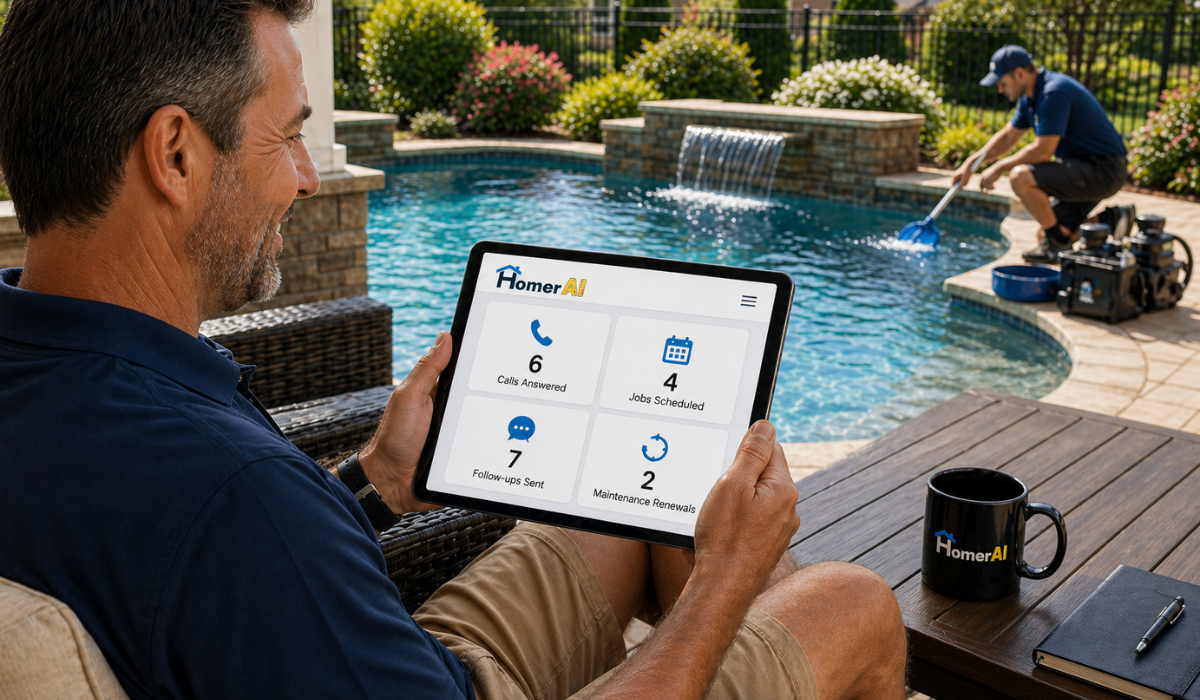
Phone support automation solves this surge problem by handling intake at scale when demand is concentrated. Every inbound call or digital inquiry receives an immediate structured response from a conversational AI voicebot, capturing service type, property details, urgency level, and preferred scheduling window. The AI booking system organizes these requests into an optimized schedule that the human team reviews and dispatches, rather than spending hours coordinating each appointment manually. This creates two simultaneous benefits: customers receive immediate acknowledgment and a clear next step instead of voicemail uncertainty, and the office team focuses on dispatching and exception management rather than reactive intake.
HubSpot research confirms that 75 percent of service leaders say AI has reduced response times and 92 percent say AI improved customer service response. Source: HubSpot. For pool service companies where seasonal surges are predictable and their impact on the customer experience is equally predictable, building AI-powered intake capacity before the surge arrives is a straightforward operational investment with an immediate return.
Can Operational Efficiency Actually Drive More Revenue From the Existing Customer Base?
Yes, and this is where the pool service business model has structural advantages over other home services categories. An active maintenance customer is already in a trusting relationship with the company. They have demonstrated willingness to pay for ongoing service, and they have seen the quality of work firsthand. They are natural candidates for equipment upgrades, pool renovation projects, chemical service plan upgrades, automation system installations, and referrals to neighbors and friends who have pools. In a manually managed operation, these conversations happen inconsistently because the office team does not have a systematic way to identify the right moment for each offer and execute outreach across the entire account base simultaneously.
AI-powered follow-up sequences create this systematic approach. When a maintenance visit identifies equipment that is approaching end of life, the system can trigger a proactive outreach sequence that presents upgrade options before the failure becomes an emergency. When a customer has been on a basic maintenance plan for two years, a renewal communication can include an upgrade offer for a higher-tier service tier. When a customer completes a positive service interaction, an automated review request improves the company's reputation score while the experience is still fresh. None of these interactions require human initiation. They happen automatically based on the triggers and schedules that the business defines during setup.
The revenue impact of consistent execution across all of these touchpoints is meaningful for a pool service company of any size. Even modest improvement in upsell conversion rate, referral generation, and review volume produces compounding revenue and margin benefits that grow alongside the account base. Conversational AI for small business makes these capabilities accessible without requiring enterprise-level technology investment, which means that independent pool service companies can compete on operational sophistication against larger regional players who have had these systems for years.
How Do Pool Service Companies Measure the ROI of AI Agent Implementation?
The most useful metrics for pool service companies evaluating AI agent performance fall into three categories: efficiency metrics, revenue metrics, and retention metrics. Efficiency metrics include average time from inbound inquiry to scheduled appointment, percentage of seasonal scheduling volume handled without human intake, admin hours spent per account per month before and after implementation, and first-contact resolution rate on routine customer inquiries. These numbers show whether the automation is actually reducing admin burden at the scale the business needs.
Revenue metrics include installation lead conversion rate before and after implementation, average installation project value for leads that went through AI-assisted intake, upsell conversion rate on maintenance accounts, and new account additions per month compared to the prior year period. These numbers connect the operational efficiency story to the business outcome story, which is what ownership ultimately cares about. Retention metrics include annual account renewal rate, cancellation rate by segment, and net promoter score trends over time. When AI-driven follow-up is catching at-risk accounts and prompting proactive engagement, these numbers should improve alongside the efficiency and revenue metrics.
Reviewing these three sets of metrics together gives pool service company owners a complete picture of how operational efficiency is translating into business strength. It also creates the feedback loop needed to refine the AI workflows over time, improving escalation logic, follow-up timing, and routing rules based on what the data reveals about where the system is performing and where it needs adjustment.
For companies operating in regions with strong climate-driven season swings, monthly forecasting accuracy is another valuable metric to watch. When AI-managed communication improves schedule predictability, owners can forecast technician utilization and chemical supply demand with less guesswork. Better forecasting reduces rush-order costs, minimizes idle service windows, and improves cash-flow planning across the season. These operational improvements do not always show up immediately as a single headline KPI, but they materially improve profitability and decision quality over time. In a business with both project revenue and recurring revenue streams, that planning stability becomes a major competitive advantage.
Conclusion
Pool installation and maintenance companies that build operational efficiency into the foundation of their business model grow revenue without the overhead spiral that characterizes manual scaling. When AI agents handle the routine communication layer, the recurring service base is managed more consistently, installation leads are captured more completely, seasonal surges are absorbed without capacity breakdowns, and the existing customer base generates more revenue through systematic upsell and referral outreach. The same team that was stretched managing 150 accounts can serve 250 or more when the admin work that grows proportionally with volume is automated rather than assigned to an already-full inbox. That is what scalability looks like in practice, and for pool service companies, the recurring revenue model makes the compounding effect of that efficiency more valuable than in almost any other home services category.
Ready To Help Your Pool Service Business Scale Revenue Without Expanding Your Office Team?
AE Technology Solutions builds AI agent systems designed for the specific operational rhythms of pool installation and maintenance businesses. We create seasonal intake workflows for spring and summer surges, recurring account communication automation for maintenance schedules, upsell and referral outreach sequences for the existing customer base, and installation lead capture and follow-up systems that improve close rates on new projects. Our conversational AI chatbot and conversational AI voicebot tools work within your existing scheduling and CRM platforms so that your team gains capacity without rebuilding their workflow from scratch. We implement an ai receptionist for pool service companies workflow, ai chatbot for pool service companies intake support, and a pool service call answering service model, including a 24 7 pool service answering service layer for after-hours customer requests. We establish the efficiency, revenue, and retention metrics that make the impact of the system visible and measurable from the first quarter of deployment. If your pool service business is generating strong demand but losing revenue to slow response, inconsistent follow-up, or seasonal admin overload, we can build the system that changes that. Visit www.aetechnologysolutions.com to schedule your strategy session and see what a scalable pool service operation looks like with the right AI infrastructure in place.
Comments