.png?width=150&height=66&name=logo_ae_tech_2-(1).png "AE Technology Solutions Logo")
.png?width=200&height=66&name=logo_ae_tech_2-(1).png "AE Technology Solutions Logo")


In HVAC, the weather writes your schedule faster than your office can. A hot Saturday can turn a quiet afternoon into a stack of no-cool calls in under an hour, and owners feel the pressure immediately. One delayed callback becomes three, routine tune-up requests collide with urgent comfort complaints, and dispatch questions keep climbing until leadership is answering messages deep into the evening. The issue is not commitment. HVAC owners are deeply committed. The issue is that demand volatility exposes every weak handoff in the communication process. When intake is inconsistent and escalation rules are unclear, ownership becomes the default safety net for the entire operation. That is how evenings and weekends disappear, even when the business is growing.
Labor economics make this harder every year. The U.S. Bureau of Labor Statistics reported private industry compensation costs rising 3.4 percent year over year through December 2025, with wages and salaries up 3.3 percent and benefits up 3.4 percent. Source: U.S. Bureau of Labor Statistics. At the same time, many small businesses are still dealing with hiring friction. The U.S. Chamber of Commerce reports that 41 percent of small business leaders have trouble filling vacancies and that more than 90 percent have struggled to find qualified applicants. Source: U.S. Chamber of Commerce. For HVAC operators, this means the old fix of adding headcount for every communication bottleneck is expensive, slow, and often unreliable during the very seasons when demand spikes hardest.
This is why HVAC teams are adopting AI agents as an operational layer, not as a novelty tool. A conversational ai chatbot handles high-volume website and text intake. A conversational ai voicebot handles inbound calls when the office is closed or overloaded. AI booking workflows capture job details, urgency signals, customer constraints, and preferred windows in a consistent format. Instead of turning every inquiry into an owner interruption, the system absorbs repetitive intake work and routes the right issues to the right person. That matters because speed and response quality now directly shape customer loyalty. HubSpot reports that 75 percent of service leaders say AI has reduced response times, while 65 percent say AI is a more efficient way to scale service than adding support staff. Source: HubSpot. In HVAC, that efficiency can be the difference between a stable operation and a business that consumes every weekend.
Why does HVAC call volume spike and steal owner weekends?
HVAC demand behaves differently from many other home services because it clusters aggressively around weather events and comfort urgency. A mild week can look manageable, then a temperature swing creates a surge where every missed call feels costly and every customer expects immediate clarity. The office is suddenly handling emergency triage, routine tune-up requests, membership questions, financing inquiries, and reschedules all at once. When intake quality drops under that pressure, dispatch quality drops right behind it. Technicians spend time clarifying job basics from the field, customers call back for updates, and the owner gets pulled into exception handling that should have been prevented upstream. The owner is not only solving difficult technical cases. They are solving avoidable communication errors. AI agents reduce this problem by stabilizing first contact during volume spikes so every inquiry starts with cleaner data and clearer expectations.
How does a 24 7 hvac answering service reduce after-hours interruptions?
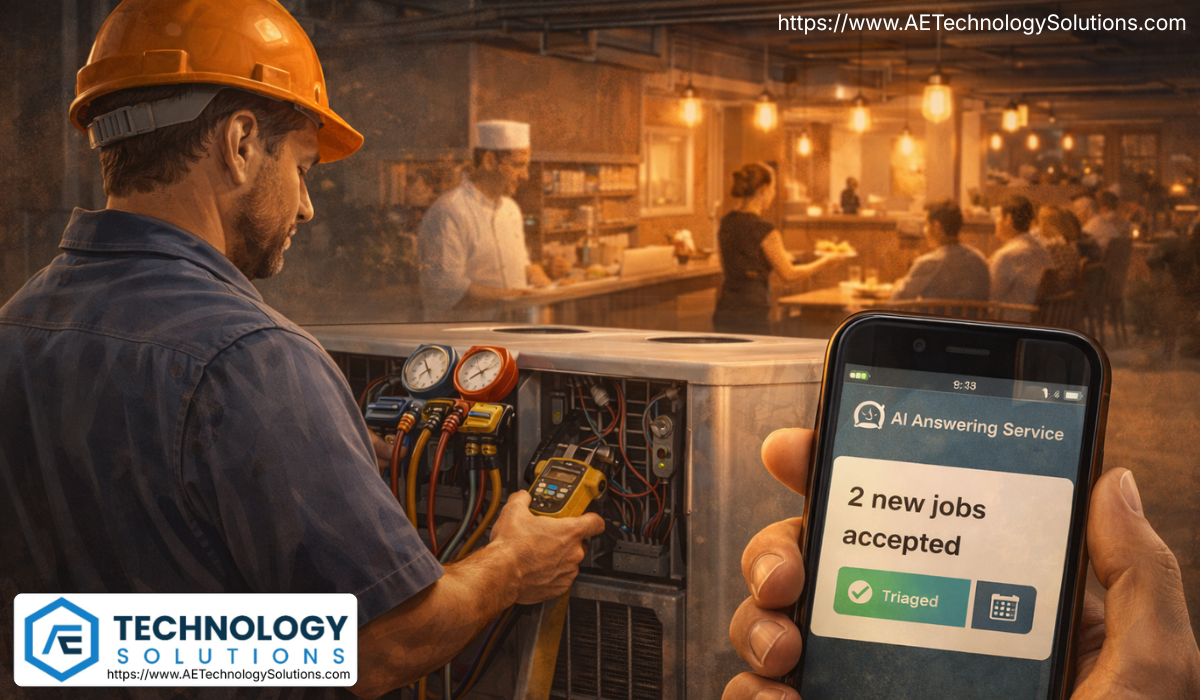
A common fear is that automation will filter too aggressively and hurt emergency response. In practice, well-designed HVAC AI does the opposite. A 24 7 hvac answering service powered by AI can distinguish between likely emergency conditions and issues that can be safely scheduled for next-day service, based on structured triage questions and predefined escalation rules. A conversational ai voicebot can gather symptom context, equipment type, occupancy concerns, and urgency cues, then route on-call alerts only when thresholds are met. A conversational ai chatbot can handle nonurgent follow-ups, appointment confirmations, and common pre-visit questions without waking up staff or ownership. The result is fewer low-value interruptions and faster handling of truly urgent situations. Owners get fewer unnecessary weekend calls, while customers still receive immediate direction and confidence that their issue is being handled responsibly.
Where does ai booking improve HVAC labor efficiency the fastest?
The biggest gains usually appear at the handoff points where HVAC teams traditionally lose time. First, intake becomes standardized, which reduces the back-and-forth office staff must do before dispatch can act. Second, ai booking workflows reduce calendar friction by capturing usable scheduling data at first contact instead of collecting it in fragments across multiple calls. Third, service teams start each day with clearer work orders, which reduces mid-route confusion and preventable callbacks. Fourth, office staff can shift from repetitive call handling to high-value work such as schedule balancing, membership follow-up, estimate recovery, and review generation. Together, these changes increase revenue output per labor hour while reducing stress-related overtime. When labor is costly and staffing is tight, improving utilization matters more than simply adding capacity.
HVAC teams also gain a major advantage in expectation management, which is often where weekend disruption begins. When customers are given precise next-step messaging at first contact, they are less likely to call back repeatedly for updates or escalate frustration before a technician arrives. AI agents can consistently set service windows, gather access instructions, confirm contact preferences, and explain what to prepare before the visit. Those details sound small, but they reduce the chain of micro-interruptions that usually pull coordinators and owners off higher-value work. During weather spikes, this consistency protects the entire operation from communication collapse. Instead of adding temporary process shortcuts that create rework later, teams can maintain stable intake quality even when volume surges. Over time, that stability lowers avoidable overtime, improves customer trust, and gives ownership more confidence that the business can run predictably outside business hours.
Can ai receptionist for hvac workflows improve offseason planning?
Yes, and this is one reason HVAC AI delivers year-round value. Most owners think first about heat waves and cold snaps, but efficiency gains are just as important during shoulder seasons. AI systems can drive consistent outbound touchpoints for maintenance reminders, membership renewals, and deferred quote follow-up, which helps smooth demand and reduce schedule volatility. A stronger offseason pipeline means fewer panic hires, fewer drastic overtime swings, and better technician workload stability once peak weather returns. HVACR industry coverage continues to highlight digital operations as a competitive differentiator as service businesses modernize customer communication and workflow management. Source: HVACR Global. Owners who use AI for both inbound and lifecycle communication typically move from reactive staffing to planned staffing, which is one of the fastest ways to reduce weekend firefighting across the year.
Another major offseason advantage is training and process consistency. During slower periods, companies can refine scripts, escalation thresholds, and data capture standards so they are ready before the next weather surge. This is where an ai receptionist for hvac strategy becomes especially valuable. Teams can test how the system handles recurring scenarios like no-heat diagnostics, membership scheduling, replacement consultations, and financing questions, then improve prompts before volume spikes return. An ai chatbot for hvac workflow can also collect intent signals that help prioritize high-value maintenance and replacement opportunities, improving close rates without forcing office staff into constant manual follow-up. These offseason improvements translate directly into fewer owner interruptions when demand accelerates, because teams and systems are already aligned.
What HVAC AI rollout model gives owners back nights and weekends?
The fastest path is to start where owner interruptions are most frequent. For many HVAC businesses, that means after-hours call handling and overflow intake during weather events. Define clear triage rules, escalation criteria, and booking boundaries first. Then connect AI outputs directly to scheduling and CRM workflows so office staff do not create new manual work to use the system. Track a short list of metrics weekly: speed to first response, after-hours escalations sent to ownership, booked jobs per inbound opportunity, overtime linked to communication cleanup, and callback volume caused by incomplete intake. Once those numbers improve, expand automation into reminder campaigns, membership retention messaging, and reactivation flows. This staged model builds trust because teams feel relief early, not disruption. For ownership, the immediate win is practical: fewer evening interruptions and more confidence stepping away on weekends.
It is also useful to define a simple escalation map for nights and weekends that everyone can follow without owner approval. For example, high-severity comfort failures in occupied homes can route to on-call dispatch immediately, medium-severity issues can trigger next-available booking with proactive customer updates, and low-severity inquiries can move to morning follow-up queues with clear response commitments. When these pathways are explicit, office staff and technicians do not need to improvise under pressure. AI handles the consistency, and humans handle judgment exceptions. That operational clarity reduces internal message traffic, shortens decision time, and protects owner availability during personal hours. Many HVAC companies find that the most meaningful quality-of-life improvement appears within the first month once escalation ambiguity is removed from after-hours communication.
For teams that want rapid adoption, start by layering AI into the exact moments where callbacks and confusion are currently highest: late-day overflow, overnight voicemail replacement, and weekend scheduling changes. A 24 7 hvac answering service can keep response speed high while collecting complete intake details for next-shift dispatch. Add phone support automation for appointment reminders, pre-arrival updates, and post-visit follow-up, and the number of owner-level escalations often falls quickly because customers are not left uncertain. This is also where ai booking workflows shine. Instead of collecting fragmented details across repeated calls, the system confirms scope, captures access information, and proposes next-step scheduling paths in one flow. The owner gains free time not because demand disappears, but because communication quality stops collapsing when volume rises.
Conclusion
For HVAC companies, AI agents are not only a staffing workaround. They are a system for protecting owner time by fixing communication inefficiency at the source. When first response is immediate, intake is structured, and escalation is disciplined, fewer routine issues spill into nights and weekends. That translates into lower overtime pressure, better schedule reliability, stronger technician utilization, and less leadership burnout. In a labor environment defined by rising costs and hiring challenges, this is not a soft benefit. Reclaimed owner time is a measurable sign that the business is operating with healthier process discipline. HVAC owners who implement AI around real bottlenecks are not just improving convenience. They are building a company that can scale demand without consuming every personal hour in return.
Ready to Run a Strong HVAC Operation Without Weekend Chaos?
AE Technology Solutions helps HVAC leaders build a weather-resilient communication engine that keeps comfort calls moving without forcing owners into after-hours triage. If your team is dealing with seasonal call spikes, membership follow-up gaps, and weekend escalation overload, we can design an implementation that starts with the pressure points costing you the most time. That includes 24 7 hvac answering service logic, ai booking workflows tied to dispatch realities, and phone support automation for confirmations, ETAs, and follow-up touchpoints. We also define KPI ownership so your coordinators, dispatch team, and managers can improve performance week by week without owner micromanagement. The goal is an HVAC business that stays responsive during heat waves and cold snaps while protecting leadership time outside the office. Visit www.aetechnologysolutions.com to schedule a strategy session and get a practical rollout plan.
Comments