.png?width=150&height=66&name=logo_ae_tech_2-(1).png "AE Technology Solutions Logo")
.png?width=200&height=66&name=logo_ae_tech_2-(1).png "AE Technology Solutions Logo")



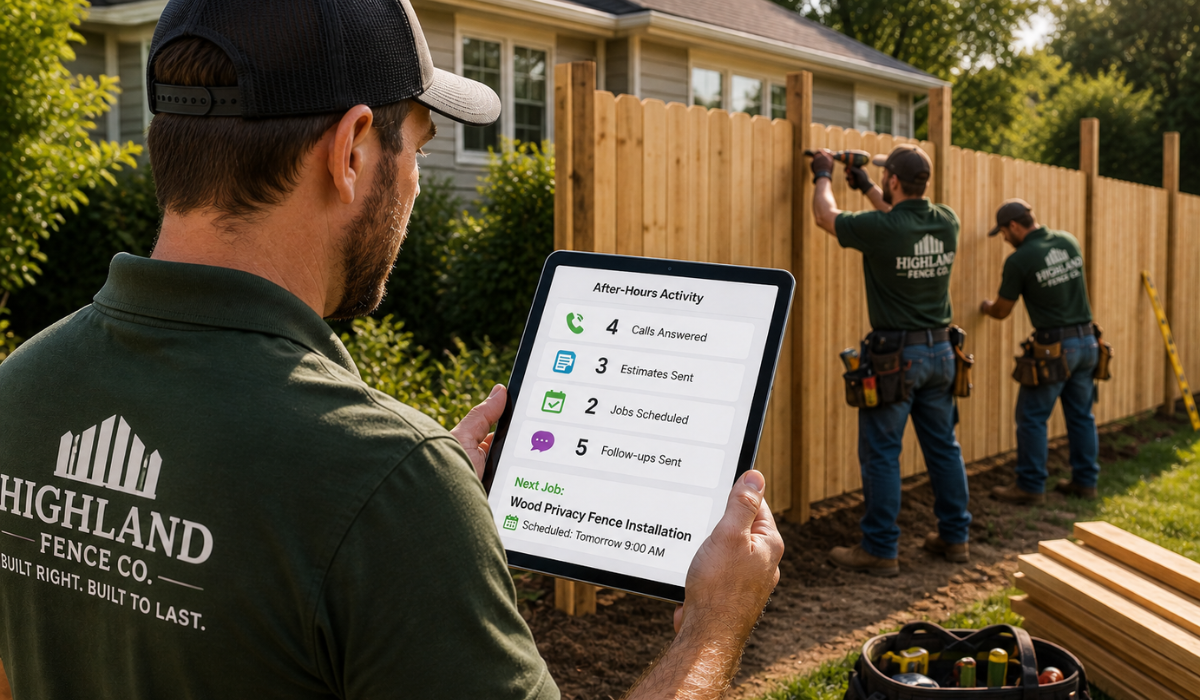
Fencing is a project-based business where the window between a customer's first inquiry and a signed contract is often short. A homeowner planning a backyard fence for spring has usually done their research in advance. They know the general style they want, they have a rough budget in mind, and when they reach out to request a quote, they are ready to move quickly. What slows them down is the response side of the equation. When a fencing company takes two days to acknowledge an inquiry, sends an estimate without following up, or loses a lead somewhere between a website form submission and the office inbox, that customer often fills the gap with a competitor who moved faster. Speed and follow-through win fencing jobs, and both of those things collapse under administrative overload.
The operational challenge for growing fencing companies is that project volume creates layered admin demands. Each new job involves an initial inquiry response, an estimate, a follow-up on that estimate, a contract and deposit collection, a material scheduling coordination step, a pre-installation confirmation, and often a post-job follow-up for reviews or referrals. Multiply that by twenty or thirty active projects in a busy season and the communication workload is substantial. Add inbound calls from new leads, questions from existing customers, and supplier coordination to the mix, and even a capable office team reaches capacity quickly. The knee-jerk answer is to hire another admin person, but that person adds overhead before they add revenue, and they are just as likely to hit the same capacity ceiling once the next growth wave arrives.
The smarter answer is to automate the portions of that communication load that do not require human expertise and redirect human attention toward the interactions that genuinely move projects forward. AI agents create that separation, and for fencing companies specifically, the estimate follow-up cycle alone represents enough recoverable revenue to justify the investment.
Where Does a Fencing Company Lose the Most Admin Time Each Week?
The four highest-volume admin time sinks in fencing operations are inbound inquiry handling, estimate follow-up, pre-installation coordination, and review and referral outreach. Inbound inquiry handling consumes disproportionate time because fencing customers often have detailed questions before they are ready to schedule a site visit. They want to understand the difference between wood and vinyl, ask about permit requirements in their area, or find out how long a standard installation takes. These are answerable questions that do not require a project manager or owner to handle, but when they arrive by phone during busy morning hours, they can each take ten to fifteen minutes of office staff attention.
Estimate follow-up is the category where revenue quietly disappears. Many fencing companies send estimates and then rely on the customer to follow up, which means that a large percentage of warm leads go cold simply because no one circled back at the right time. A study by the Harvard Business Review found that companies that tried to contact leads within an hour of a web inquiry were nearly seven times likelier to qualify the lead than those who waited even an hour longer. Source: Harvard Business Review. In fencing, where the average job value can be several thousand dollars, even modest improvement in estimate close rate represents a significant revenue gain. Pre-installation coordination, including confirming start dates, communicating what the customer needs to do to prepare the site, and verifying access details, is similarly repetitive and automatable. Post-job review outreach almost never happens consistently in manual operations because it is always pushed out by the next priority.
How Does AI Booking Improve Estimate Conversion in Fencing?
AI booking changes the estimate conversion process by removing the timing gap that causes most leads to go cold. When a prospective customer submits an inquiry, a conversational AI chatbot can immediately acknowledge the request, confirm receipt, collect project details such as fence type, linear footage estimate, material preference, and desired timeline, and schedule the site visit or estimate appointment without requiring a human to coordinate the back-and-forth. The customer has a confirmed next step within minutes of reaching out, which sets a positive first impression and reduces the probability that they shop competitors in the meantime.
The follow-up sequence is equally important. After an estimate is delivered, an AI-driven follow-up workflow can send a check-in message at a defined interval, address common objections with prepared responses, and flag the lead for human outreach when specific signals, such as repeated opens or a direct reply, indicate readiness to move forward. This is not aggressive sales automation. It is a systematic way of staying present with a prospective customer during the consideration period without requiring the office team to manually track and time each outreach. For a fencing company sending thirty estimates per week, automating this follow-up sequence can recover a meaningful percentage of leads that would otherwise close with competitors simply because a faster follow-up arrived first.
The scheduling efficiency extends beyond new leads. Existing customers who need to confirm installation dates, ask about permit timelines, or request a change to their project scope can interact with an AI agent that handles the intake and routes the request appropriately. This reduces inbound phone volume for the office team and eliminates the communication gaps that frustrate customers during the project coordination phase. When customers feel informed and well-managed throughout the process, review scores improve, referrals increase, and the revenue per customer relationship grows over time.
Can Phone Support Automation Handle Permit and Material Questions Without Losing Customers?
One concern that fencing company owners raise about automation is whether AI can handle the complexity of their customer conversations. Fencing customers do ask specific questions about permits, HOA regulations, material comparisons, and installation timelines that seem to require expert knowledge. The answer is that a well-designed AI agent does not need to replace expertise. It needs to handle the first layer of common questions accurately and route genuinely complex or unusual inquiries to the right human quickly. Most of the questions that consume office time in fencing operations are not genuinely complex. They are the same fifteen questions repeated by different customers, and they have consistent answers that can be built into a knowledge base the AI uses to respond.
Phone support automation with this design reduces the number of calls that require human handling without eliminating human involvement in the interactions that actually matter. An owner or project manager who previously spent an hour each morning answering routine inbound questions can instead spend that time reviewing project quality, following up on unpaid invoices, or developing relationships with supply chain contacts. These are the activities that improve margins and sustain long-term growth, and they consistently get deprioritized when routine communication absorbs the day. A conversational AI voicebot or conversational AI chatbot that handles the intake and filtering layer restores that priority balance without requiring the business to hire a dedicated intake coordinator.
According to a survey from Salesforce, 77 percent of service professionals say that automation allows them to complete more work with fewer resources, and 69 percent say AI helps them spend more time on cases that require complex knowledge. Source: Salesforce State of Service Report. For fencing companies where the most valuable conversations are the ones that close projects and generate referrals, keeping human attention on those conversations while automation handles everything else is the operational model that scales.
How Does Operational Efficiency Enable a Fencing Company to Take on More Projects?
Project capacity in a fencing business is usually constrained first at the installation crew level, then at the project management level, and finally at the admin level. Most owners assume the admin bottleneck is the last one to matter, but in practice, admin constraints show up earlier than expected because project management gets pulled into intake, scheduling, and coordination tasks that are actually admin work. When project managers spend time rescheduling confirmed appointments, answering questions that an AI could handle, and chasing outstanding estimate approvals, they have less time for the site assessments, crew oversight, and supplier relationships that determine project quality and scheduling efficiency.
Automating the admin layer returns project managers to project work, which increases the number of projects a single manager can oversee without reducing quality. A fencing company with two project managers who each spend 30 percent of their time on admin tasks effectively operates with less than one and a half managers' worth of project oversight. Remove that admin burden through AI booking and phone support automation, and those same two managers can handle a meaningfully higher project load. Combined with the improved lead conversion that comes from faster response and consistent estimate follow-up, the total revenue capacity of the business increases without adding a single new hire. That is the scalability that AI-powered operational efficiency delivers in practice, and it compounds as the business grows.
What Does the Revenue Model Look Like When Admin Costs Stay Flat While Volume Grows?
Revenue scaling without proportional admin hiring changes the unit economics of a fencing business in ways that improve profitability as volume grows rather than keeping margins flat. In a traditional model, each 20 percent increase in project volume might require a corresponding increase in office staff to maintain service quality, which absorbs much of the margin gain from the volume increase. In an AI-assisted model, admin capacity scales without proportional cost increases because the automated layer handles the communication volume expansion. The margin on incremental revenue is higher, which means the same growth rate produces better bottom-line results.
Conversational AI for small business tools make this model accessible to fencing companies of any size. The investment is a fraction of what additional headcount would cost annually, and the system improves lead capture, follow-up consistency, scheduling efficiency, and post-job outreach simultaneously. Each of those improvements influences revenue in a different part of the customer lifecycle, which means the ROI case is not dependent on a single metric performing perfectly. Even partial improvement across all four areas produces a revenue impact that outpaces the cost of the technology and the time invested in implementation.
There is also a branding advantage that many fencing businesses overlook. Companies that respond quickly, provide clear status updates, and follow up professionally are perceived as premium operators even when their pricing is market-competitive. That perception influences close rates and referral behavior in ways that are difficult to replicate with paid ads alone. Operational efficiency, in this context, becomes part of the brand promise customers talk about with neighbors and HOA groups. As this reputation compounds, marketing efficiency improves because more leads arrive with higher initial trust, which further increases revenue without requiring additional administrative staffing to support growth.
This is especially relevant in local markets where word-of-mouth and neighborhood social groups heavily influence contractor selection. Consistent communication becomes a revenue moat.
Conclusion
Fencing companies that are growing in competitive local markets cannot afford to let admin inefficiency act as a ceiling on their capacity. Every estimate that goes unfollowed, every lead that waits too long for a response, and every project that loses a referral because no one asked for a review is revenue left behind. AI agents address all of these gaps simultaneously by automating the routine communication tasks that consume office hours without producing proportional value. The result is a fencing operation that captures more leads, closes more estimates, coordinates projects more smoothly, and generates more referrals with the same team it already has. That is what operational efficiency looks like when it is designed to drive revenue and not just reduce workload.
Ready To Build a Fencing Business That Closes More Estimates and Scales Without Adding Overhead?
AE Technology Solutions helps fencing companies design AI agent workflows around the specific operational patterns of project-based contracting. We build estimate follow-up sequences, inbound lead capture systems, pre-installation coordination automation, and post-job review outreach processes that run consistently without requiring additional office headcount. Our AI booking and conversational AI chatbot tools integrate with your existing scheduling and CRM systems so that your team benefits from the automation without changing how they manage active projects. We deploy an ai receptionist for fencing companies workflow, ai chatbot for fencing companies routing logic, and a fencing call answering service model, including a 24 7 fencing answering service layer for after-hours quote capture. We track the metrics that matter for fencing operations, including estimate close rate, lead response speed, and referral conversion, so you can see the revenue impact clearly as the system scales with your business. If your office team is working hard but growth is still creating more admin pressure than capacity relief, we want to show you how to change that. Visit www.aetechnologysolutions.com to schedule a strategy conversation and get a customized operational efficiency roadmap.
Comments