.png?width=150&height=66&name=logo_ae_tech_2-(1).png "AE Technology Solutions Logo")
.png?width=200&height=66&name=logo_ae_tech_2-(1).png "AE Technology Solutions Logo")


For many home services owners, the business follows them home long after the trucks are parked. The office closes, but the phone still lights up. A web lead comes in during dinner. A technician needs clarification during a child’s ballgame. A customer leaves a frustrated voicemail on Saturday morning, and the owner feels they have to jump in because they do not trust that the system will catch up cleanly on Monday. This is one of the most common forms of burnout in the trades: constant partial attention and a feeling that every evening is only temporarily yours. AI agents matter in this environment not just because they improve revenue capture, but because they help restore a healthier boundary between running the company well and being permanently on call for every communication breakdown. When the intake system gets stronger, the owner gets back something many growing businesses quietly lose: real personal time.
That change is becoming more important as labor pressure continues to rise. The U.S. Bureau of Labor Statistics reported that private industry compensation costs rose 3.4 percent over the year ending in December 2025, with wages and salaries up 3.3 percent and benefits up 3.4 percent. At the same time, the U.S. Chamber of Commerce reports that 41 percent of small business leaders have trouble filling job vacancies and that more than 90 percent have struggled to find qualified applicants. For home services businesses, that creates a familiar trap. The team is busy enough to need more support, but hiring is slow, expensive, and uncertain. So owners end up absorbing the overflow themselves. They answer the missed calls, patch the scheduling confusion, and carry the mental load after hours. AI offers a more sustainable path. It gives the business another layer of coverage that captures demand, structures communication, and reduces the number of moments when leadership has to personally rescue the workflow. Sources: U.S. Bureau of Labor Statistics, U.S. Chamber of Commerce.
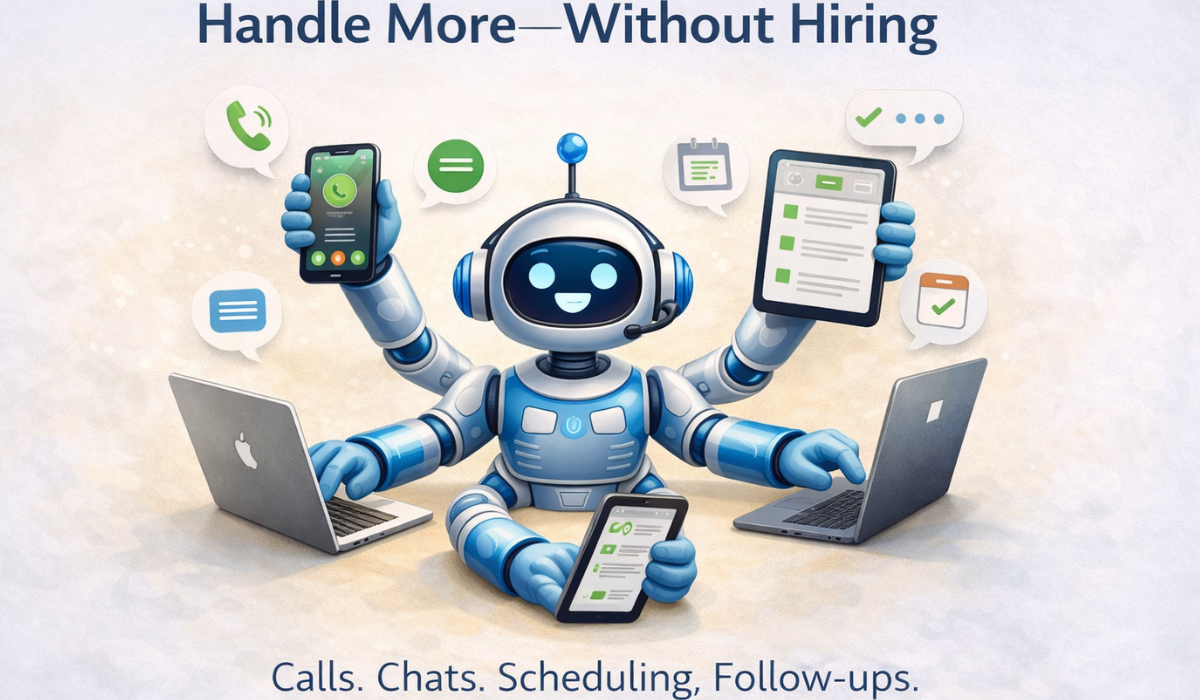
This is why the conversation around AI in home services should be broader than efficiency alone. A conversational AI chatbot can answer routine questions and qualify web leads. A conversational AI voicebot can handle after-hours calls and route urgent issues properly. AI booking automation can improve scheduling quality and reduce administrative friction. But the bigger outcome is stability. Customers get a faster first response. Office staff get fewer repetitive interruptions. Dispatch gets cleaner information. Technicians get better work orders. The owner gets fewer surprise escalations at night and fewer weekends spent catching up on what the system dropped earlier in the week. In other words, AI helps restore home life by fixing revenue capture and operational reach at the source.
Why Do Home Services Owners Lose So Much Free Time In The First Place?
Most owners do not lose family time because the company is successful. They lose it because the company is inconsistent. A missed call here, a vague intake note there, a delayed follow-up on a high-intent lead, and a customer who has to repeat the same issue three times can all seem small in isolation. Together, they create a constant stream of preventable problems that bubble upward to the owner. The owner becomes the unofficial backup CSR, backup dispatcher, and backup service recovery manager because no one else has full confidence in how the front end is being handled. That pattern steals time in fragments, which is one reason it becomes so normal. It is not always a full crisis. It is a dozen small interruptions spread across evenings and weekends. AI agents reduce those interruptions by making first response and routing more dependable. When every call or inquiry follows a structured path, fewer loose ends survive to the end of the day, and fewer issues follow the owner home.
How Does Better Revenue Capture Translate Into More Time At Home?
Revenue capture and free time are closely connected, even though owners often think of them separately. When the business misses calls or handles leads poorly, the owner does not just lose revenue. They inherit more follow-up work, more second-chance conversations, and more anxiety about whether the marketing budget is being wasted. A home services call answering service powered by AI changes that equation by keeping the first contact moving even when the office is overloaded or closed. A conversational AI voicebot can answer after-hours calls, collect the core job details, and determine whether the issue needs immediate escalation. A conversational AI chatbot can do the same across web and text channels without forcing the office to monitor every message in real time. This protects revenue because more opportunities get handled while intent is high. It also protects time because the owner is not waking up to a pile of damaged leads, unclear voicemails, and avoidable customer frustration from the night before. The business starts the next day in a more controlled position, and that reduces the habit of checking in constantly after hours.
What Changes When AI Booking Automation Cleans Up The Schedule?
A surprising amount of owner stress comes from problems that begin with poor scheduling inputs. If the intake details are weak, dispatch makes assumptions. If dispatch makes assumptions, technicians call back from the field. If technicians call back from the field, office staff scramble to clarify the job and customers start losing confidence. By the time the issue reaches the owner, it feels like a field problem even though it really started as a communication problem. AI booking automation helps stop that chain reaction earlier. It can require key details such as issue type, urgency, location, access notes, and preferred timing before a job reaches the calendar. That improves route quality and reduces preventable schedule friction. It also lowers the amount of cleanup work that spills into the end of the day. Instead of spending evenings reviewing what went wrong or answering frustrated messages, owners can step away knowing the next day’s board is built on better information. That is where operational discipline starts to feel personal. Better scheduling does not just save time inside the office. It gives leadership back time outside of it.
How Does AI Expand Reach Without Expanding Chaos?
Growth is often what steals free time fastest in home services. A company adds marketing, reaches into new zip codes, or expands into adjacent services, and suddenly the owner feels more needed than ever. More calls come in, but the communication process has not matured enough to support them. AI helps solve that by letting businesses expand operational reach without depending entirely on more human availability at the front end. A plumbing, HVAC, electrical, or cleaning company can use AI to qualify new leads, screen service-area fit, handle overflow volume, and set next-step expectations more consistently across more channels. The U.S. Chamber also reports that 87 percent of small businesses say technology platforms have increased efficiency and that 1 in 4 are already using AI. Digital leverage is increasingly how small businesses grow without letting complexity consume leadership time. Source: U.S. Chamber of Commerce.
Can AI Improve Family Time Without Making Customer Service Feel Cold?
Yes, if it is designed honestly and used for the right parts of the customer journey. Customers are generally not asking whether a human or AI answered first. They are asking whether the response was fast, useful, and clear. HubSpot reports that 75 percent of service leaders say AI has helped reduce response times, while 92 percent say AI improved customer service response. Salesforce also found that 72 percent of customers want to know when they are interacting with an AI agent. Those two points work together. Customers are comfortable with AI when it is transparent and when it improves the experience instead of blocking it. In home services, that means AI should identify itself, collect practical information, and make escalation to a human easy when the situation is emotional, unusual, or urgent. When it works that way, service feels more dependable, not less personal. That actually helps restore family time for owners because customer trust is stronger, fewer issues escalate after hours, and the business no longer depends on the owner’s constant availability to feel responsive. Sources: HubSpot Customer Service Statistics, Salesforce State of the Connected Customer.
What Does Reduced Overtime Have To Do With Owner Quality Of Life?
More than many owners realize. Overtime is not only a payroll issue. It is usually a sign that communication and scheduling waste are spilling past the normal workday. The U.S. Department of Labor notes that covered nonexempt employees must receive overtime pay for hours over 40 in a workweek at not less than time and one-half their regular rates. In home services, those extra hours often come from returning missed calls late, reconstructing weak notes, fixing booking mistakes, and managing customer frustration that should have been prevented at first contact. When staff stay late, the owner often stays mentally engaged too, either by approving decisions, answering texts, or stepping in directly. AI agents help reduce that sprawl by taking over the repetitive first layer of communication and by feeding cleaner information into the workflow earlier. The result is not only lower overtime risk. It is a business that winds down more cleanly at the end of the day, which makes it far easier for ownership to be present at home instead of remaining half-attached to the office all evening. Source: U.S. Department of Labor.
What Should Owners Measure If They Want Proof That AI Is Giving Time Back?
The right scorecard should include business metrics and personal-life metrics. On the business side, owners should track speed to first response, booked jobs per inbound lead, after-hours capture rate, callback volume caused by incomplete intake, and overtime hours tied to communication cleanup. On the personal side, they should also watch how often leadership gets pulled into after-hours interruptions, how many weekend messages require direct involvement, and whether technicians and office staff are escalating fewer preventable issues. These are practical indicators of whether AI is truly reducing dependency on the owner or just adding another piece of software. The strongest rollouts start small, often with after-hours intake or overflow lead handling, then expand into confirmations, reminders, review requests, and reactivation workflows once the team feels the relief. That staged approach matters because the goal is not only to improve efficiency on paper. It is to create a business that can grow, stay responsive, and still let the owner be home without feeling that every unanswered inquiry is a threat.
Conclusion
For home services businesses, AI agents are increasingly valuable because they solve a problem that sits at the intersection of revenue and quality of life. They help capture more of the demand that is already trying to reach the company, and they reduce the communication disorder that keeps owners tethered to the business after hours. When first response is immediate, booking is more structured, and after-hours coverage is dependable, the company becomes easier to trust and easier to manage. That improves operational reach, protects revenue, and restores something many owners have slowly lost as they grew: the ability to be truly present at home. In a labor market where hiring remains difficult and customer expectations remain high, that is not a side benefit. It is one of the clearest signs that the business is finally becoming sustainable.
Ready To Build A Business That Gives Time Back?
AE Technology Solutions helps home services companies implement practical AI workflows for intake, booking, and after-hours response. If you want to capture more opportunities without giving up more evenings and weekends in return, visit www.aetechnologysolutions.com to learn more.
Comments