.png?width=150&height=66&name=logo_ae_tech_2-(1).png "AE Technology Solutions Logo")
.png?width=200&height=66&name=logo_ae_tech_2-(1).png "AE Technology Solutions Logo")


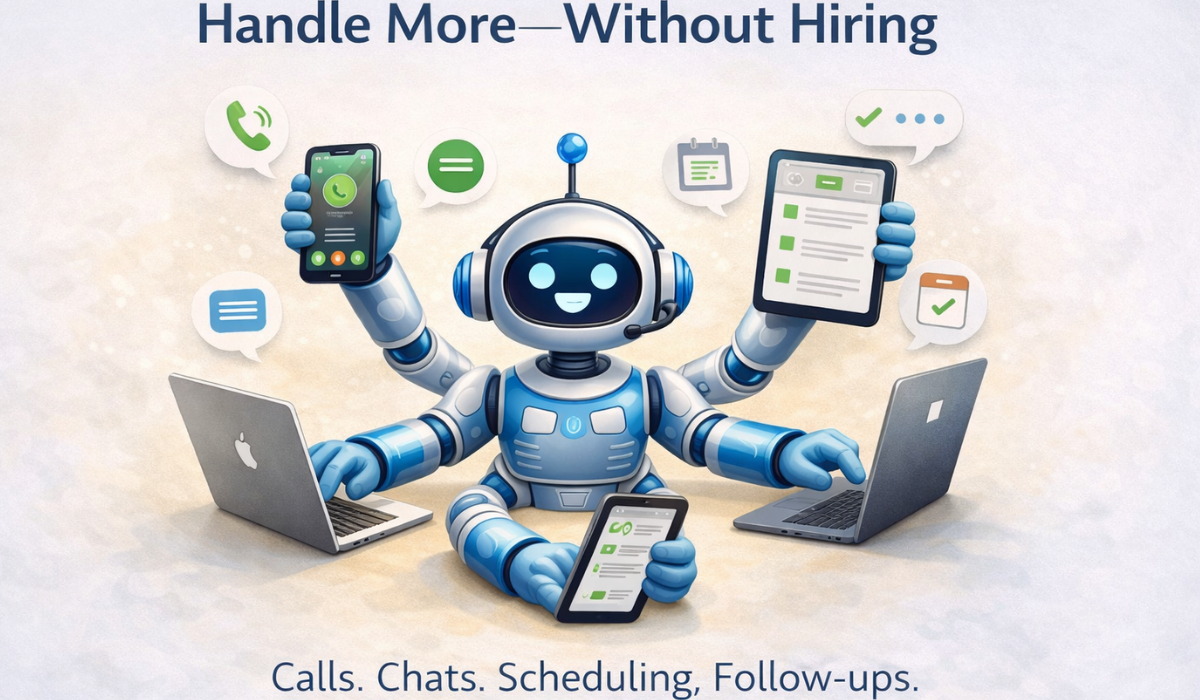
Growth in home services has always carried a painful irony. The more successful your business becomes, the more it strains at the seams. Calls pile up before any additional staff member is hired, trained, and confident enough to handle intake alone. Schedules fill faster than they can be managed. Follow-up tasks accumulate because everyone on the team is already doing two people's work. The traditional answer to all of this is to hire. Add a receptionist. Hire another dispatcher. Bring on a second office coordinator. But each hire introduces months of recruiting effort, onboarding complexity, payroll expansion, and benefit overhead, and there is still no guarantee the new employee handles calls with the consistency the business needs to protect customer relationships. For most home services owners, each growth milestone simply introduces a new version of the same bottleneck. That cycle of growth and strain is not inevitable. It is a workflow design problem, and AI agents are solving it for plumbing, HVAC, electrical, and cleaning companies right now.
AI agents create a fundamentally different scalability model for home services businesses by separating communication capacity from headcount. When a conversational ai chatbot handles website and text inquiries around the clock, a conversational ai voicebot manages inbound calls with structured intake, and booking automation processes scheduling requests without manual intervention, the business absorbs higher call volume, faster lead response, and more consistent follow-up without adding a single employee. This matters in a market environment where staffing has become a genuine constraint on growth. According to the U.S. Chamber of Commerce, 41 percent of small business leaders say they cannot find workers to fill open positions, and more than 90 percent report difficulty finding qualified applicants. Source: U.S. Chamber of Commerce. At the same time, the U.S. Bureau of Labor Statistics reports that private industry compensation costs rose 3.4 percent year over year through December 2025, with wages up 3.3 percent and benefits up 3.4 percent. Source: U.S. Bureau of Labor Statistics. In that environment, adding staff every time call volume grows is not only slow, it is increasingly expensive.
The mechanics behind this scalability shift are worth understanding in detail because they change how owners think about growth planning entirely. Traditional growth models tie revenue expansion directly to labor expansion. You can book more jobs this quarter, but if you cannot answer calls faster, follow up on estimates more reliably, or schedule with greater precision, capacity limits reassert themselves before the revenue opportunity is fully realized. AI agents decouple those constraints by handling the communication and administrative tasks that cause growing businesses to feel perpetually understaffed. The skilled employees you already have, typically your experienced office staff, service coordinators, and dispatch team, stop spending the bulk of their time on repeatable intake and information-relay tasks. They redirect toward higher-value activities: converting estimate leads into signed jobs, resolving escalated situations, managing field communications, and building customer relationships that generate referrals. That reallocation is the engine behind growth without hiring. AI handles the high-volume, low-judgment work so your people can do the high-value, high-judgment work that actually moves revenue forward. The business gets bigger without feeling bigger from the inside.
Why Do Home Services Companies Struggle To Scale Without Adding Staff?
The answer is almost always found in communication workflows, not in the field. Service delivery capacity in most home services businesses can keep pace with moderate growth because technicians and crew members can absorb additional jobs within existing routes and schedules. The real ceiling appears in intake, follow-up, scheduling, and customer communication. Every new customer added to the pipeline requires someone on the phone, in the chat queue, or at the keyboard to handle the interaction at each stage of the relationship. When that communication volume grows faster than office headcount, response times slip, follow-up goes incomplete, and jobs fall out of the pipeline before they ever convert to booked revenue. The problem intensifies because demand in home services is seasonally uneven. HVAC companies face surge volume in summer and winter. Plumbing and restoration companies spike after weather events. Cleaning companies experience seasonal peaks around holidays and move-out cycles. These surges require communication capacity that peaks briefly and then contracts significantly. Hiring for peaks means carrying payroll overhead in the valleys between them. AI agents absorb those surges without that trade-off. A conversational ai chatbot handles ten simultaneous web inquiries as easily as it handles one, and that capacity is always available regardless of the season, time of day, or current staffing level. That core difference in how AI scales versus how hiring scales is what makes AI agents such a powerful tool for growth-stage home services businesses.
How Does An AI Receptionist Service Create Immediate Capacity For Home Services Companies?
An ai receptionist service built for home services handles the first and most critical communication moment: when a potential customer reaches out for the first time. Response speed at that point is not simply a courtesy. It is a commercial reality. Research from Harvard Business Review found that companies contacting inbound leads within one hour were nearly seven times more likely to qualify the lead than those that waited any longer. Source: Harvard Business Review. In home services, where customers frequently reach out to multiple companies simultaneously, that response window is even tighter. An ai receptionist service answers immediately, every time, without hold times, voicemail dead-ends, or office hours limitations. It captures structured intake details, qualifies the type of service needed, routes urgent requests appropriately, and books available time slots without requiring a human to be present for each exchange. That immediate response capacity does not change with total call volume. Whether twenty people call on a quiet Monday morning or two hundred call during a regional storm event, the system handles each one with the same structure, speed, and accuracy. A growing business that deploys this kind of ai receptionist service is effectively adding a communication layer that never gets overwhelmed, never transfers a caller to voicemail because someone is already on the line, and never loses intake details because the conversation happened too fast. That is instant scalability that no traditional hiring plan can replicate.
How Does Booking Automation Improve Revenue Output Per Labor Hour?
Booking automation improves revenue productivity in three compounding ways that compound over time as volume grows. First, it converts more inbound leads by responding and booking before a competitor does. Second, it reduces the admin time required per booked job by automating intake, confirmation, and reminder steps that currently consume meaningful office hours every week. Third, it improves schedule quality by capturing service constraints, access details, and customer preferences early so fewer jobs require revision, reschedule, or field clarification once dispatch has occurred. According to HubSpot, 75 percent of service leaders say AI has reduced response times for their teams, and 92 percent say AI tools improved overall customer service response quality. Source: HubSpot. For home services businesses, the financial impact compounds as volume increases. If a plumbing team answers 30 percent more inbound requests because they are no longer missing calls or responding too late, and those additional requests convert at the same close rate as current jobs, revenue grows without a proportional increase in admin labor. Booking automation also reduces the number of callbacks triggered by incomplete intake, which is one of the most consistent sources of hidden office labor waste in home services companies. When intake is complete at first contact, office staff spend less time reconstructing job details and more time advancing revenue-producing tasks.
Can Conversational AI For Small Business Replace The Need For An Additional Hire?
The honest answer is that conversational ai for small business does not replace people. It reallocates what people do, which is ultimately more valuable to the business. The typical office hire in a growing home services company spends the majority of their time on tasks that follow predictable, repeatable scripts: answering the phone, asking intake questions, logging job details, giving availability windows, confirming appointments, sending reminders, and handling routine status inquiries. A well-configured conversational ai chatbot and conversational ai voicebot can handle all of those tasks consistently and at scale, without fatigue, without variability, and without requiring supervision. That frees the existing office employee to spend their time on tasks that require genuine judgment and relationship skill: converting a hesitant estimate caller into a signed agreement, managing a complex multi-service job request, handling a frustrated customer situation with real empathy, or following up on high-value accounts that have not booked in several months. When businesses make this reallocation deliberately, they typically find they can grow revenue by 20 to 40 percent before the office labor requirement actually increases in a meaningful way. The key insight is that AI handles volume so humans can handle value. That is how conversational ai for small business creates a substantial growth window before any additional headcount is genuinely necessary.
What Does Sustainable Growth Look Like With Phone Support Automation In Place?
Sustainable growth for a home services company means the business can absorb more volume without operational quality degrading under that additional load. Phone support automation is one of the clearest enablers of that model because it removes the communication bottleneck that typically causes customer experience to deteriorate at exactly the moments when demand is highest. When a weather event drives a spike in emergency plumbing or HVAC calls, or when a new marketing campaign generates a sudden surge in inbound leads, phone support automation ensures every contact receives an immediate, structured response rather than a busy signal or a voicemail box. That prevents the lead bleed that occurs when call volume exceeds office capacity, which is often when the most motivated buyers are calling. It also preserves customer trust during high-stress service moments, which directly improves both conversion rates and review volume. Over time, this creates a compounding growth dynamic. Faster lead response improves booked job rates. Better intake quality reduces wasted truck rolls. Consistent follow-up improves review volume over time. More reviews strengthen inbound lead flow organically. Each of those improvements reinforces the others. AI agents make that dynamic more reliable by maintaining consistent communication quality across all touchpoints regardless of how quickly the business is growing. A home services company that captures this operational advantage can outpace competitors and grow margins simultaneously because revenue is increasing faster than operating costs.
Conclusion
Home services businesses do not need to accept the trade-off between growth and operational strain. AI agents break that trade-off by creating a communication and intake capacity layer that scales with demand rather than with headcount. The businesses that deploy an ai receptionist service, implement booking automation, and use conversational ai for small business in their intake workflows are finding they can book more jobs, respond faster, and deliver better customer experiences at higher volume with the same or smaller office teams. That is not a marginal improvement. It is a structural shift in how the business operates and how growth compounds over time. The owners who make this shift stop measuring their capacity by how many people they have on phones and start measuring it by how well their communication systems convert inbound interest into booked revenue. In a market where hiring is difficult, compensation costs are rising, and competition for inbound customers is intensifying across every trade category, scalable communication infrastructure is no longer a luxury feature for growing home services companies. It is the operational foundation that makes real growth accessible without requiring every revenue milestone to be matched by a new job posting.
Ready to Scale Your Home Services Business Without Your Next Hire?
AE Technology Solutions works with home services companies across plumbing, HVAC, electrical, and cleaning to build AI agent systems that create immediate and durable scalability. Whether you are responding to seasonal volume spikes, running out of office capacity during a growth phase, or consistently losing booked jobs because your communication infrastructure cannot keep pace with inbound demand, we design a practical implementation around the specific workflows where your growth is stalling. That includes ai receptionist service configuration, booking automation, phone support automation, conversational ai chatbot deployment, and escalation logic built for your call types and service categories. We also set up measurement frameworks so you can track lead response rates, booking conversion improvements, callbacks from incomplete intake, and office labor hours recovered through automation. The result is a business that grows its revenue capacity before it grows its payroll. Visit www.aetechnologysolutions.com to schedule a strategy session and get a phased implementation roadmap built for your home services operation.
Comments