.png?width=150&height=66&name=logo_ae_tech_2-(1).png "AE Technology Solutions Logo")
.png?width=200&height=66&name=logo_ae_tech_2-(1).png "AE Technology Solutions Logo")


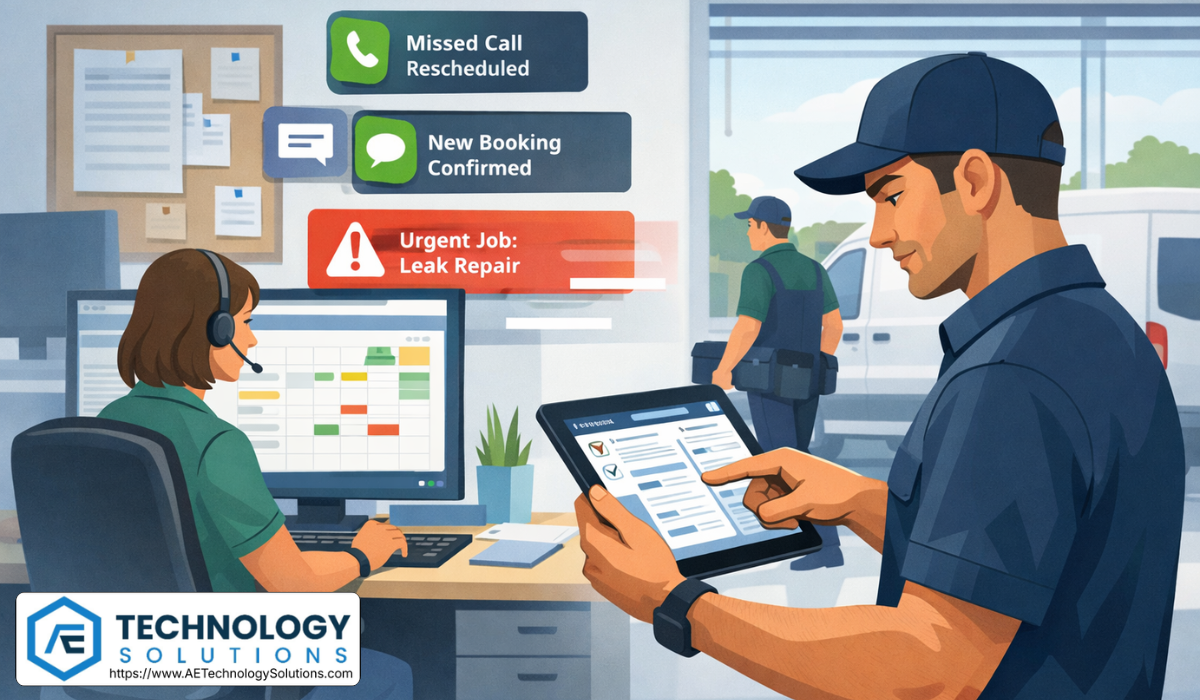
Every home services owner knows the pattern. The phones spike when the office is already stretched, technicians need answers while they are in the field, and after-hours calls show up just as payroll risk starts climbing. It is not only a staffing problem. It is a labor efficiency problem. When office coordinators spend half the day repeating appointment windows, screening basic requests, chasing missing customer details, and relaying messages that should have been captured correctly the first time, expensive labor hours get consumed by low-leverage work. At the same time, every missed call can turn into a missed booking, every delay can force unnecessary overtime, and every hiring gap can put more pressure on the people who stayed. That combination is why AI agents have moved from novelty to operating tool across the home services industry. They are not there to replace craftsmanship, judgment, or relationship-building. They are there to take repetitive communication work off the critical path so human labor gets used where it creates the most value.
Labor pressure is not easing for small and midsize operators. The U.S. Bureau of Labor Statistics reported that private industry compensation costs rose 3.4 percent over the year ending in December 2025, with wages and salaries up 3.3 percent and benefits up 3.4 percent. That matters because most home services companies do not have the margin cushion to absorb wage inflation, benefit growth, inefficient dispatching, and overtime leakage all at once. At the same time, hiring is still difficult. The U.S. Chamber of Commerce notes that 41 percent of small business leaders report trouble filling job vacancies and that more than 90 percent have struggled to find qualified applicants. Sources: U.S. Bureau of Labor Statistics and U.S. Chamber of Commerce. In that environment, the smartest operational move is rarely to keep adding headcount for every workflow bottleneck. It is to redesign the bottleneck so each employee can support more revenue, more customers, and more schedule stability without burning out.
That is where AI agents fit. A modern home services stack can use a conversational ai chatbot on the website and SMS channel, a conversational ai voicebot for inbound calls, and ai booking workflows that capture job details in a standardized format before a human ever touches the request. Instead of acting like a generic autoresponder, the system works like an always-on intake layer. It can answer common questions, qualify urgency, gather property and service details, route emergencies based on rules, confirm booking preferences, and escalate edge cases when needed. The result is not simply faster response time, although that matters. HubSpot reports that 75 percent of customer service leaders saw the highest ever ticket volumes and that 75 percent say AI has helped reduce response times, while 65 percent view AI as a more efficient way to scale service operations than adding more support staff. Source: HubSpot. For home services companies, that combination translates directly into a better use of labor dollars.
Why is labor efficiency such a big profit lever in home services?
In most trades, labor is the largest controllable cost category and the biggest constraint on growth. Trucks, tools, software, insurance, and marketing matter, but the day-to-day performance of the business still depends on how effectively people move through work. If a customer service rep needs eight minutes to gather details that could be captured in two, the cost is not limited to six wasted minutes. That drag compounds across every call, every callback, every reschedule, and every handoff to dispatch. If a technician leaves a job without complete notes because the office is too busy to coordinate the next step, that confusion can create idle time on the next appointment or drive time that never gets billed. If the owner is constantly filling communication gaps after hours, overtime or personal burnout becomes the hidden tax on growth. AI agents improve labor efficiency by compressing low-value steps and making high-value labor more productive. Office staff can spend more time on exception handling, customer retention, pricing conversations, and route management. Field teams get better information faster. Owners gain a clearer operating rhythm instead of running the business through interruption.
How do AI agents reduce hiring pressure without lowering service quality?
Most home services companies do not need fewer people. They need fewer people trapped in repetitive work that does not justify rising wage costs. Hiring another coordinator or receptionist may solve today’s call volume problem, but it can also create more recruiting time, training effort, payroll burden, and management overhead. AI agents give businesses another option: increase coverage and consistency without adding the same fixed labor cost for every new block of demand. A home services call answering service powered by AI can handle the first layer of customer contact instantly, including nights, weekends, and seasonal surges. That means the business can keep service levels high even when it is short-staffed or hiring takes longer than planned. It also makes the existing team easier to retain because they are not carrying the entire burden of repetitive inbound traffic. The point is not to create a cold, automated experience. The best systems clearly identify themselves, collect the right information, and pass context to a human when emotion, complexity, or policy requires it. That improves service quality because customers get speed first and human judgment when it matters most, rather than waiting in a queue for every type of request.
Where do AI agents have the biggest impact on overtime and after-hours expense?
Overtime often looks like a scheduling issue, but it is usually an information issue first. The U.S. Department of Labor reminds employers that covered nonexempt employees must receive overtime pay for hours over 40 in a workweek at not less than time and one-half their regular rates. Source: U.S. Department of Labor. In home services, those extra hours accumulate when the office stays late returning missed calls, when on-call technicians get routed without enough context, and when dispatch teams have to repair booking mistakes after the regular day should have ended. AI agents reduce that overtime pressure by absorbing routine volume before it becomes end-of-day cleanup. A conversational ai voicebot can answer after-hours calls, distinguish emergencies from routine requests, gather complete job details, and send only the right escalations to the on-call person. A conversational ai chatbot can confirm arrival windows, answer common service-area questions, and capture quote requests without requiring a human to monitor every channel in real time. Even when human follow-up is still needed, the follow-up starts with organized information instead of a blank slate. That shortens call handling time, reduces rework, and keeps costly after-hours labor focused on genuine exceptions rather than preventable administrative overflow.
How do AI agents improve both office productivity and field productivity?
Many owners evaluate automation only through the lens of call answering, but the bigger advantage is coordination quality. When intake is inconsistent, the office loses time cleaning up notes and the field loses time operating on incomplete information. AI agents improve both sides of that equation. On the office side, they standardize intake, reduce duplicate data entry, support phone support automation, and free team members to work on schedule optimization, outbound follow-up, review generation, maintenance membership outreach, and unresolved estimate recovery. On the field side, technicians benefit from cleaner work orders, clearer urgency signals, and better expectations before they leave for a job. That can reduce wasted windshield time, lower the odds of sending the wrong skill set to the wrong problem, and improve the number of productive service hours a technician can generate in a day. HubSpot also reports that 92 percent of customer service decision-makers say AI improved customer service response and that AI helps teams scale service operations more efficiently. Source: HubSpot. In practical terms, that means office labor stops bottlenecking field labor, which is one of the fastest ways to improve margin without squeezing technicians harder.
Can AI agents help control hidden labor costs beyond payroll?
Yes, and this is where many owners underestimate the return. Labor cost is not just wages, benefits, and overtime. It includes recruiting effort, onboarding time, turnover risk, supervisor interruptions, unbilled troubleshooting calls, rescheduling friction, no-show follow-up, and the opportunity cost of leadership time pulled into low-value coordination. AI agents help control these hidden costs because they make service delivery more predictable. Standardized intake reduces the frequency of bad-fit appointments. Better confirmation workflows can lower no-show rates and reduce the need for reactive schedule patching. Fast responses can capture more high-intent leads before they call the next provider, which raises revenue per labor hour already on the payroll. Better documentation at first contact also protects reviews and repeat business because customers feel informed instead of ignored. The U.S. Chamber also reports that 87 percent of small businesses said technology platforms increased efficiency and that 1 in 4 small businesses are already using AI, which shows that digital leverage is increasingly becoming part of standard small-business operations rather than an experimental edge case. Source: U.S. Chamber of Commerce. When a company has to hire, train, and retain fewer people just to keep up with communication volume, management attention can move toward process improvement and revenue growth. That is why conversational ai for small business should be viewed as an operational discipline, not just a software category. It protects labor capacity, improves the yield on every paid hour, and lowers the chaos tax that quietly erodes margins in growing service businesses.
What is the smartest way for a home services company to adopt AI agents?
The strongest rollout starts small, ties directly to a labor bottleneck, and measures outcomes weekly. Begin with the communication lane creating the most expensive friction, usually missed calls, after-hours volume, or inconsistent intake from web and SMS. Define the policies first: what the AI agent can answer, what information it must capture, what qualifies as an emergency, and when the conversation must move to a human. Then connect the workflow to the scheduling and CRM systems the team already uses so the business is not creating a second layer of manual work. The first set of metrics should be operational, not theoretical: speed to answer, booked jobs per inbound opportunity, after-hours escalation volume, average handling time, overtime hours tied to administrative cleanup, and customer follow-up lag. Once those numbers improve, expand into ai booking confirmations, maintenance reminders, review solicitation, and reactivation campaigns. This phased model matters because adoption succeeds when employees feel relief, not threat. When the office staff sees that repetitive work is shrinking and technicians see that work orders are getting cleaner, buy-in gets easier. The technology works best when it is introduced as a system for better labor allocation, stronger customer experience, and healthier growth.
Conclusion
For the home services industry, AI agents are not primarily a story about replacing people. They are a story about using people better. When labor is expensive, hiring is difficult, and overtime can quietly distort margins, the businesses that win are the ones that protect human time for the work only humans should do. AI agents handle the repetitive layer of communication that clogs schedules and drains payroll efficiency: answering routine questions, capturing complete job details, routing requests, supporting ai booking, and maintaining coverage outside normal office hours. That improves response speed, reduces administrative rework, lowers after-hours burden, and makes the existing team more productive without forcing more strain into the week. Over time, those gains show up in the numbers owners care about most: steadier labor costs, better technician utilization, higher booking capture, and less burnout at the leadership level. In a market where labor pressure is unlikely to disappear, operational efficiency is one of the few advantages a company can build deliberately.
Ready to Improve Labor Efficiency Without Adding More Chaos?
AE Technology Solutions helps home services companies design AI agent systems that reduce hiring strain, control overtime, and make every labor hour work harder. If you want to evaluate a conversational ai chatbot, conversational ai voicebot, ai booking workflow, or a complete communication strategy for your office and field teams, we can map the highest-friction parts of your operation and build a phased rollout around measurable business goals. That includes intake logic, escalation rules, integration planning, KPI tracking, and change management so the system supports your team instead of overwhelming it. The goal is simple: capture more revenue, lower the labor waste hidden inside missed calls and rework, and give your staff a workflow they can actually sustain during busy seasons. Visit www.aetechnologysolutions.com to schedule a strategy session and see how AI agents can turn labor efficiency into a real competitive advantage for your home services business.
Comments