.png?width=150&height=66&name=logo_ae_tech_2-(1).png "AE Technology Solutions Logo")
.png?width=200&height=66&name=logo_ae_tech_2-(1).png "AE Technology Solutions Logo")



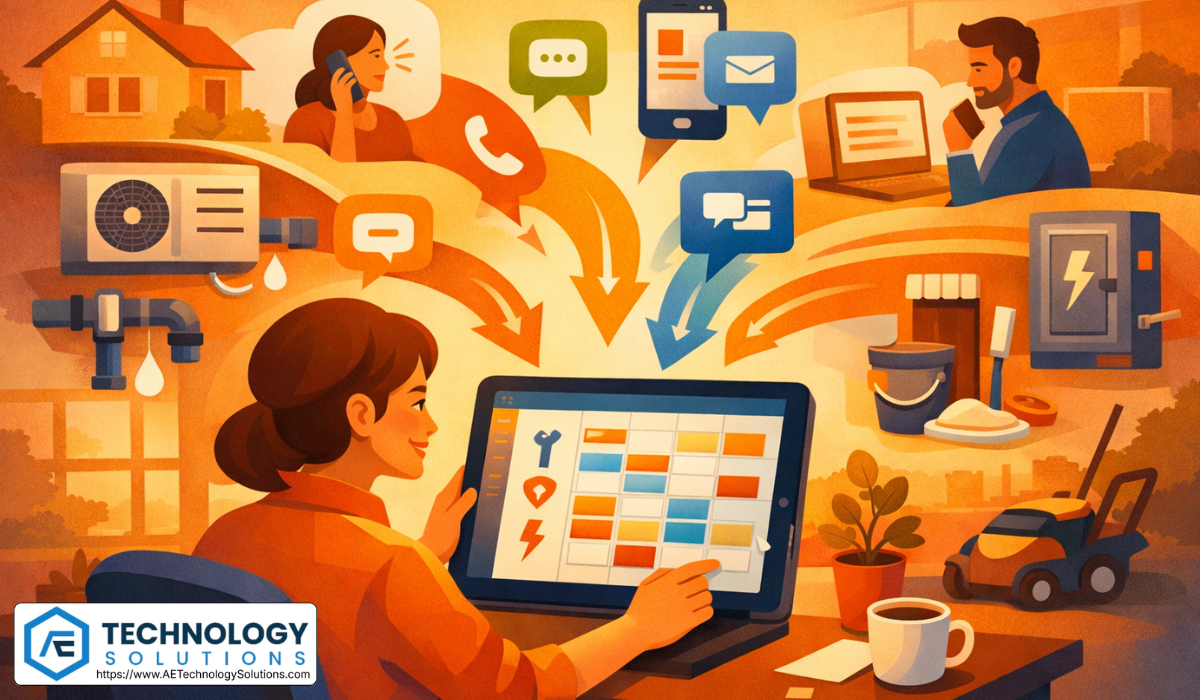
Home services companies lose meaningful revenue every week because demand arrives faster than teams can respond. A homeowner with a broken AC unit, a leaking water heater, a failing electrical panel, or an urgent cleaning request rarely waits long for a callback. They contact multiple providers, compare responsiveness, and choose the company that feels reliable from the first interaction. When calls go unanswered or digital inquiries are delayed, businesses do not just lose one appointment. They lose trust, reputation momentum, and often long-term customer value tied to maintenance plans, repeat projects, and referrals. That is why communication speed has become a margin issue, not only a service issue. An ai receptionist service helps close this gap by giving home services businesses continuous first-response coverage with consistent intake quality. Instead of forcing office staff to absorb every inquiry in real time, teams can capture demand systematically, route urgency correctly, and protect conversion opportunities that would otherwise leak out of the pipeline before anyone gets a chance to follow up.
The challenge is not limited to one trade. HVAC, plumbing, electrical, pest control, cleaning, landscaping, roofing, and remodeling teams all face the same operational pressure: high customer expectations, uneven demand patterns, and limited administrative capacity. During peak seasons or weather-driven spikes, call volume can double quickly while office staffing remains flat. Even high-performing teams struggle to maintain speed and consistency when conversations are fragmented across calls, forms, text messages, and social channels. A conversational ai chatbot gives owners a practical way to stabilize this chaos by standardizing first contact and collecting the details needed for faster, cleaner handoffs. Customers get immediate guidance, and internal teams get structured context rather than scattered notes. This shift improves confidence on both sides of the interaction. Buyers feel heard early, and teams stop spending valuable hours correcting intake errors, chasing incomplete requests, or triaging avoidable confusion that slows dispatch and hurts close rates.
The ROI impact becomes obvious when communication workflows are connected to booking, scheduling, and follow-up performance. With ai booking automation, qualified inquiries can move into open slots faster, emergency requests can escalate with clear rules, and routine jobs can be routed without repetitive manual intervention. Phone support automation further reduces friction by handling confirmation calls, reminders, and status updates that typically consume significant coordinator time. Together, these capabilities transform communication from a reactive cost center into a measurable growth system. Instead of relying on intuition to judge performance, owners can track conversion velocity, booking quality, labor efficiency, and customer sentiment in one operating loop. The result is not simply more activity. It is more profitable activity with stronger control over staffing, cash flow timing, and service-level consistency during seasonal peaks and slower periods. In the sections below, we break down how these systems recover lost revenue, why response speed matters across every home services category, which metrics leadership teams should monitor, and how conversational ai for small business can scale without sacrificing quality or brand trust.
How Does AI Receptionist Service Recover Lost Revenue Across Trades?
The fastest way to improve ROI is to recover demand that already exists. Most home services companies spend heavily on local SEO, paid ads, referral programs, wrapped vehicles, and reputation management to generate inbound interest. When those inquiries are missed, delayed, or poorly qualified, the business pays acquisition cost without receiving the revenue outcome. An ai receptionist service helps recover that value by ensuring every lead receives immediate engagement and structured next steps regardless of office availability. This is especially important after hours, during weekends, and during sudden demand surges when staffing gaps are most visible. HubSpot service research consistently highlights response speed and communication quality as core drivers of customer satisfaction and retention. In home services, that principle has direct financial consequences because buyers often book the first provider that communicates clearly and confidently. By reducing response delay and intake inconsistency, businesses improve close rates, protect marketing ROI, and create a more reliable foundation for recurring service revenue.
The recovery effect grows when businesses combine speed with better qualification. A conversational ai chatbot can gather issue type, service address, urgency, preferred schedule, and project context before a human handoff happens. That upfront structure helps coordinators prioritize high-fit opportunities quickly and avoid wasted back-and-forth that erodes trust. Broader productivity analysis from McKinsey supports this approach, showing strong gains in customer operations where workflows are repeatable and rules-driven. For home services, this means fewer lost leads, fewer unnecessary callbacks, and fewer scheduling errors that damage customer perception. Teams can spend more time on decisions that require human expertise and less time on repetitive intake tasks that add little strategic value. Over a quarter, these improvements often compound into stronger booking consistency, better revenue predictability, and healthier utilization of both field and office resources.
Why Does Speed to Response Matter in Every Home Services Category?
Speed matters because urgency exists in every vertical, even when the service is not an emergency by definition. HVAC failures affect comfort and health, plumbing issues risk property damage, electrical concerns raise safety anxiety, and renovation timelines impact household planning. Even routine cleaning, lawn care, and pest control decisions are heavily influenced by convenience and perceived reliability. Customers interpret response speed as a proxy for future service quality. If communication is slow at the buying stage, they assume scheduling, arrival windows, and issue resolution will also be inconsistent. NAHB economic reporting and broader housing market trend data from the Joint Center for Housing Studies at Harvard reinforce how home investment behavior changes with economic pressure, which makes conversion efficiency even more important during uncertain demand cycles. In practical terms, faster and clearer first contact helps businesses win more of the demand they are already paying to attract.
Response speed also affects internal execution quality. When inquiries are handled late, teams often rush scheduling and skip important qualification steps to keep up. That leads to mismatched technician assignments, incomplete job prep, and avoidable revisit costs. By contrast, phone support automation and ai booking automation create a steadier intake rhythm that improves planning quality before work begins. Dispatchers receive cleaner data, field teams arrive with better context, and customers experience fewer surprises. This consistency has strong downstream effects on profitability because fewer mistakes mean fewer non-billable corrections and fewer reputation hits from preventable service friction. Over time, businesses that prioritize communication speed with process discipline can preserve margin more effectively than competitors who treat call handling as an administrative afterthought. In crowded markets, that operational reliability becomes a durable differentiator that drives repeat work and referral growth.
How Do AI Booking Automation and Phone Support Automation Improve Margins?
Margin improvement starts with reducing labor waste in repetitive communication tasks. Many home services businesses rely on highly capable office staff whose time is consumed by confirmations, reminders, routing updates, and basic status questions. These tasks are necessary, but they often crowd out higher-value work such as estimate follow-up, escalation management, and customer retention outreach. AI booking automation shifts much of this routine load into consistent workflows that execute quickly and accurately. Phone support automation extends the benefit by maintaining proactive communication before and after appointments, reducing no-shows and minimizing scheduling gaps. When these systems are configured well, teams can maintain service quality without adding equivalent headcount as demand grows. This is one of the clearest pathways to improving contribution margin while scaling.
Margin gains also come from better calendar quality and fewer preventable errors. Home services profitability depends on matching the right work to the right time with the right resource. Poor intake quality breaks that chain and creates expensive inefficiencies, including idle technician windows, rushed dispatch decisions, duplicate travel, and incomplete job preparation. A conversational ai chatbot improves this process by collecting complete information early and applying consistent routing logic before jobs are booked. Better data at intake leads to better decisions across scheduling, dispatch, and customer communication. Over several months, these workflow gains usually show up as improved revenue per technician day, lower overtime pressure, and stronger close-to-completion efficiency. Businesses often discover that they do not need more leads first. They need better lead handling discipline to convert existing demand into profitable production.
What KPIs Should Owners Track to Prove ROI with Confidence?
A strong KPI framework should connect communication performance to financial outcomes. At minimum, owners should monitor answer rate, speed to first response, booking rate, no-show rate, and conversion from inquiry to completed job. These indicators reveal whether ai receptionist service workflows are improving core funnel movement. Next, track operational metrics such as dispatch accuracy, first-visit completion rate, average time to schedule, and office overtime tied to communication load. Together, these measures show whether automation is reducing friction or simply shifting it. Teams should also segment performance by service line and lead source to identify where gains are strongest and where script or routing changes are needed. This level of clarity helps leadership make smarter decisions about staffing, ad spend, and territory expansion.
The most effective organizations pair KPI dashboards with weekly quality reviews. Numbers alone can show what changed, but interaction reviews explain why it changed. Reviewing call transcripts and chat summaries helps teams evaluate whether the conversational ai chatbot is asking the right questions, setting clear expectations, and routing to the best next step. It also helps identify opportunities to refine messaging for different customer contexts, such as emergency calls versus planned project inquiries. Energy.gov guidance and ENERGY STAR resources highlight how homeowner decision-making improves with clear, actionable information, and the same principle applies to service communication quality. When qualitative review and quantitative tracking are combined, businesses build a continuous optimization loop that supports sustainable ROI rather than one-time gains.
Can Conversational AI for Small Business Scale Without Losing Quality?
Yes, if implementation is phased and governed with clear operating standards. The best approach is to start with high-volume, lower-complexity workflows such as first-response intake, appointment confirmations, and follow-up reminders. Once these processes are stable, teams can expand into more nuanced scenarios like estimate qualification, maintenance plan outreach, and multi-step project nurturing. This phased rollout reduces disruption, improves team adoption, and creates cleaner measurement checkpoints so leadership can see which changes are producing real outcomes. Conversational ai for small business succeeds when it is treated as an operational system, not a one-time software toggle. That means ownership, training, script governance, and regular performance tuning must be built into the rollout plan.
Quality at scale also depends on preserving brand voice and customer trust. Home services buyers are not looking for robotic interactions. They want clarity, speed, and confidence that their request is being handled correctly. A well-designed conversational ai chatbot can provide that experience while handing off complex issues to human staff with full context intact. This hybrid model keeps technical decision-making and relationship-building in human hands while automation handles consistency and throughput. As companies expand into new zip codes, add service lines, or face seasonal demand changes, the combination of ai receptionist service, phone support automation, and ai booking automation helps maintain service standards without proportional administrative growth. Over time, that reliability builds reputation equity that directly supports long-term revenue quality.
Conclusion
Home services businesses improve ROI when communication is managed as a strategic growth function rather than a reactive support task. An ai receptionist service protects demand capture, a conversational ai chatbot improves intake consistency, and ai booking automation with phone support automation turns that consistency into stronger scheduling, conversion, and retention outcomes. The financial impact is measurable across lead recovery, labor efficiency, and margin quality. Companies that adopt disciplined measurement and continuous workflow tuning typically outperform peers who still rely on fragmented manual communication processes. In a market where speed and trust shape customer decisions quickly, reliable communication infrastructure is no longer optional. It is a core competitive advantage for sustainable growth across the home services industries. The businesses that win long term are often not the ones with the biggest teams first, but the ones with the cleanest operating systems and the most consistent customer experience at every touchpoint, from first inquiry to final follow-up and repeat-service retention.
Ready to Transform Your Home Services Business?
AE Technology Solutions helps home services companies deploy AI systems that are practical, measurable, and aligned with real operational workflows. We implement ai receptionist service capabilities, conversational ai chatbot interactions, ai booking automation, and phone support automation in one cohesive framework tailored to your business model. Whether you run one trade or multiple service lines, the goal is the same: capture more qualified demand, reduce communication bottlenecks, and improve conversion quality without adding unnecessary overhead. If you are ready to scale with conversational ai for small business use and clear ROI accountability, visit www.aetechnologysolutions.com to schedule a strategy session. You will receive a rollout roadmap, KPI model, and optimization plan designed to deliver consistent performance as your business grows. We also help teams define ownership, reporting cadence, and quality standards so improvements remain durable month after month, even as demand shifts and new service lines are added. This gives leadership clear visibility, predictable execution, and a practical path to long-term growth that remains resilient in changing local market conditions.
Comments