.png?width=150&height=66&name=logo_ae_tech_2-(1).png "AE Technology Solutions Logo")
.png?width=200&height=66&name=logo_ae_tech_2-(1).png "AE Technology Solutions Logo")


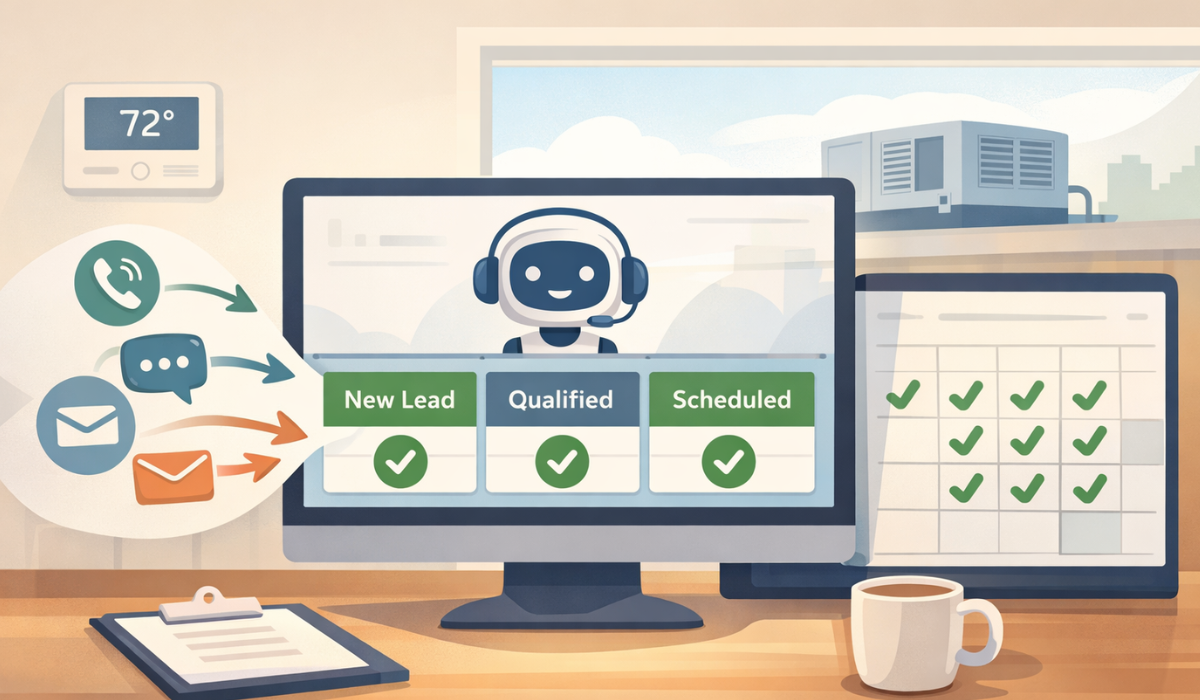
Every HVAC owner knows the same hard truth about growth: demand does not fail first, operations fail first. The phone spikes when weather shifts, office capacity collapses for a few hours, and profitable jobs quietly leak into voicemail. A missed no cooling call on a July afternoon is not a small miss, it is a lifetime value event handed to another contractor. A delayed follow-up on a maintenance lead is not a harmless delay, it is the start of lower close rates, lower route density, and higher acquisition cost per booked ticket. Most teams try to solve this by hiring faster, asking dispatch to do more, or pushing technicians into communication work they were never trained to own. That strategy creates stress, overtime, and inconsistent customer experiences that damage reviews over time. An AI receptionist for HVAC changes the operating model. It gives your company a consistent intake and booking layer that works every hour, captures detail before handoff, and protects your human team for work that requires judgment. This is not a generic automation conversation. It is a practical playbook for owners who want tighter capacity control, cleaner workflows, and margin protection in a market where speed and reliability decide who wins first and who scales last. It also reshapes leadership decisions because forecasting and staffing become tied to cleaner intake data instead of assumptions made during peak-day chaos. When managers can see real inquiry patterns, urgency mix, and booking bottlenecks by hour and channel, they can tune schedules and service windows with far greater precision.
HVAC businesses are being squeezed from both sides, and those pressures are structural, not seasonal. On one side, staffing remains difficult across skilled trades, while wage pressure and overtime costs continue to challenge predictable profitability. On the other side, customers now expect immediate responses, transparent timelines, and smooth scheduling from the first touchpoint to the final invoice. Research from the U.S. Chamber of Commerce continues to show workforce constraints for small businesses, while customer experience research from Salesforce shows that fast and consistent service strongly affects loyalty and switching behavior. Source: U.S. Chamber of Commerce. Source: Salesforce State of the Connected Customer. HVAC operators cannot solve this environment by adding ad spend alone. More leads into the same communication bottleneck usually means more waste, not more growth. The companies that outperform are redesigning intake, triage, and scheduling as systems. They use AI to make first response immediate, qualification consistent, and dispatch handoff cleaner. That approach lifts conversion from the demand you already generate, reduces preventable overtime, and gives managers clearer visibility into where work is won, delayed, or lost.
That is why the most useful framing is not AI versus people. The right framing is process quality at scale. A conversational AI voicebot on inbound calls, an AI chatbot for HVAC on web and SMS, and policy-driven AI booking automation can work together as one front door for your business. Instead of relying on whichever coordinator is free at a given minute, the system follows the same logic every time: confirm service area, identify urgency, collect equipment and symptom details, set next steps, and route the request to the right workflow. This creates consistency customers feel immediately. It also creates operational discipline your team can build on. HubSpot service trend reporting repeatedly highlights the business impact of faster response and structured service workflows on retention and satisfaction. Source: HubSpot Service Trends. For HVAC companies, this matters most during peak stress windows when errors multiply and handoffs break. AI gives you a stable intake layer exactly when your team is most overloaded. The result is not less human service. The result is better human service because your people spend less time chasing missing details and more time solving real comfort problems for customers.
How Does An AI Receptionist For HVAC Improve First-Contact Conversion?
Conversion starts before your team ever presents a quote. It starts with whether the prospect feels heard, helped, and guided in the first two minutes. A traditional HVAC call answering service often struggles during call surges because every interaction depends on live staff availability and experience. An AI receptionist for HVAC closes that gap by answering instantly, asking structured questions, and moving each caller toward a clear next action. If the issue is urgent, the system can flag emergency pathways and prioritize dispatch callbacks. If the issue is standard, it can collect model details, symptom history, and preferred windows so scheduling begins with context, not guesswork. This is where margin impact begins, because cleaner intake reduces rework and increases same-day booking probability. It also improves marketing efficiency, since more inbound opportunities become booked work without additional lead spend. Source: Forbes on customer response speed. Over a quarter, that compounding effect is substantial: fewer abandoned inquiries, fewer dropped callbacks, and higher close rates from the demand you already pay to generate. In practical terms, the biggest win is not just answering more calls. It is answering with structure that creates trust and momentum from first touch to scheduled visit.
Why Does A 24 7 HVAC Answering Service Reduce Overtime Pressure?
Overtime in HVAC often rises for reasons that are not truly technical. Teams stay late because notes are incomplete, callbacks pile up, and urgent requests were captured poorly after hours. A 24 7 HVAC answering service powered by conversational AI voicebot reduces this spillover by standardizing how every after-hours interaction is recorded and routed. The office arrives in the morning to organized queues with priority labels, customer context, and recommended next steps. That means coordinators spend less time triaging chaos and more time booking productive routes. It also reduces end-of-day cleanup that quietly extends payroll hours. The U.S. Department of Labor overtime guidance makes clear how quickly labor expense can escalate when inefficiency pushes teams beyond standard hours. Source: U.S. Department of Labor. AI helps by removing the repetitive communication burden that creates those late-hour admin blocks. It is not eliminating staff value. It is protecting staff from low-leverage work that causes burnout. Over time, this shift improves retention and schedule predictability while giving managers cleaner control over labor cost per completed job. For owners, that matters as much as top-line growth, because consistent margin discipline is what funds expansion, marketing, and leadership development year after year.
How Can AI Booking Automation Improve Technician Utilization?
Technician utilization is one of the most important and most misunderstood drivers in HVAC profitability. Most owners track hours worked, but fewer track how many of those hours are spent on preventable communication gaps. When AI booking automation captures complete intake details up front, dispatch can assign the right technician with higher confidence. That reduces avoidable revisits, lowers idle windshield time, and improves first-trip completion rates where possible. Clean scheduling inputs also support tighter route planning, which increases billable work inside the same labor window. This is especially valuable during shoulder seasons when companies need to maximize conversion of maintenance and replacement opportunities without overloading crews. Source: ServiceTitan field service benchmark content. The key is consistency. A human-only intake model can be excellent one hour and uneven the next depending on call load. AI enforces process consistency every hour, then hands the case to your team with usable context. That lets dispatch focus on optimization rather than transcription. Better utilization also improves customer outcomes, because shorter arrival windows and fewer reschedules increase trust and lower cancellation risk. In effect, AI turns scheduling from a reactive task board into a controlled production system aligned with capacity, geography, and profitability goals. As those gains stabilize, owners can also plan training and upsell conversations more intentionally, since techs arrive with clearer job context and can spend more time on customer education about maintenance plans and system lifecycle choices.
What Role Does An AI Chatbot For HVAC Play In Customer Trust?
Trust in HVAC is built through reliability, clarity, and confidence under stress. Customers contacting your business during a no heat night or a no cooling afternoon are not evaluating your brand on slogans. They are evaluating whether communication is immediate and whether next steps are clear. An AI chatbot for HVAC supports that trust by giving customers instant answers on service area, availability, and what information to prepare before a visit. It can also support multilingual interactions and accessible digital communication for customers who do not want to call. When integrated with your workflow, the chatbot can send appointment confirmations, preparation checklists, and status updates that reduce uncertainty. That consistency lowers inbound repeat calls asking for updates, which further protects office bandwidth. Source: Zendesk customer experience trends. Importantly, trust improves most when AI is paired with explicit human handoff rules for complex or sensitive cases. Customers should always know when a team member is stepping in and what happens next. Done correctly, the system feels professional and human-centered, not robotic. Over months, this communication quality shows up in better review volume, stronger referral momentum, and higher rebooking rates for memberships and preventative service agreements.
How Should HVAC Companies Implement AI Without Disruption?
The lowest-risk implementation path begins with one measurable bottleneck, not a full-stack rollout on day one. For many HVAC firms, the best starting point is missed-call recovery plus after-hours triage, because both connect directly to lost revenue and overtime cost. Define a baseline before launch: answer rate, time to first response, booking rate from inbound inquiries, and admin overtime hours tied to communication cleanup. Then configure the AI workflows with concrete business rules. Include mandatory intake fields, emergency escalation logic, service-area filtering, and clear thresholds for human handoff. Integration is non-negotiable. If your AI receptionist service does not feed your CRM or dispatch system cleanly, you create duplicate work and team resistance. Train office staff and field leaders together so everyone understands how AI supports their outcomes. In the first ninety days, review transcripts, edge cases, and conversion trends weekly, then tune scripts and routing. This operating cadence matters more than vendor hype. Source: McKinsey on AI implementation and value capture. HVAC companies that treat AI as an iterative process discipline, not a one-time tool purchase, are the ones that convert early wins into durable gains in margin, speed, and customer confidence.
Conclusion
HVAC growth becomes durable when communication quality becomes predictable. An AI receptionist for HVAC gives you that predictability by making first response immediate, intake consistent, and scheduling handoffs cleaner across every hour of the week. A 24 7 HVAC answering service protects your brand during the exact moments competitors lose trust through delays and voicemail dead ends. AI booking automation improves technician utilization by reducing preventable friction, and an AI chatbot for HVAC strengthens customer confidence with clearer expectations and faster updates. None of these gains rely on removing people from the equation. They rely on putting people where they create the most value while AI handles repetitive flow management with discipline. For owners, the strategic advantage is compounding: better conversion from current demand, better labor efficiency, better service experience, and better margin stability through seasonal volatility. In a market where customer expectations keep rising and staffing constraints remain real, this is no longer a future-state experiment. It is an operating decision about whether your business runs on heroics or systems. The firms that choose systems now will scale with less chaos, stronger reviews, and more control over both growth and profitability in the years ahead. They will also gain better forecasting confidence, because communication data becomes a reliable early indicator of demand shifts, technician load, and service mix changes that usually take weeks to see in revenue reports alone.
Ready To Modernize Your HVAC Front Line?
AE Technology Solutions helps HVAC companies deploy practical AI systems that drive measurable outcomes without disrupting day-to-day operations. We design and implement AI receptionist service workflows, conversational AI voicebot call handling, AI chatbot for HVAC journeys, and AI booking automation tied directly to your existing dispatch and CRM processes. Our approach starts with your highest-friction bottleneck, then builds a phased rollout focused on conversion lift, response speed, technician utilization, and overtime control. You get a clear implementation roadmap, transparent performance metrics, and ongoing optimization support so value grows after launch rather than fading after setup. Whether you are scaling a single market or managing multiple service territories, we help you build a communication layer that captures demand consistently and protects team bandwidth during peak load. The objective is simple: win more qualified jobs from the demand you already generate while delivering a customer experience that strengthens reviews, referrals, and long-term retention. We also help your leadership team establish weekly operating reviews so you can monitor answer rate, booked-job quality, overtime drift, and customer follow-through in one practical dashboard, then adjust scripts and routing quickly as conditions change. Visit www.aetechnologysolutions.com to schedule a strategy session and see how a modern HVAC call answering service can help your company grow with greater control, stronger margins, and less operational stress. If you want a low-risk starting point, we can launch with after-hours intake and missed-call recovery first, validate gains in 30 to 60 days, and then scale into full AI workflows only after your team is seeing measurable operational relief and revenue impact.
Comments