.png?width=150&height=66&name=logo_ae_tech_2-(1).png "AE Technology Solutions Logo")
.png?width=200&height=66&name=logo_ae_tech_2-(1).png "AE Technology Solutions Logo")


In home services, growth rarely breaks because demand disappears. It breaks because the operation cannot absorb demand fast enough, consistently enough, or profitably enough. A new lead calls while the office line is tied up. A returning customer reaches voicemail after hours and books with a competitor by morning. A dispatcher spends twenty minutes chasing basic details that should have been captured on first contact. A technician arrives without full context and loses billable time solving communication gaps before solving the actual issue. None of those moments looks dramatic in isolation, but together they form a quiet revenue leak that compounds every week. AI agents are becoming essential in this environment because they turn communication into an always-on operating system rather than a fragile queue that depends on who is available in the moment. For contractors and service business owners, that shift is no longer about novelty. It is about creating a repeatable engine that captures more opportunities, protects team capacity, and supports profitable growth across seasons, staffing cycles, and changing customer expectations. It also changes how leaders think about capacity planning because the business stops treating incoming demand like an interruption and starts treating it like an asset that can be processed with discipline. When that mindset takes hold, the company can grow with less operational turbulence and stronger confidence in day-to-day execution.
The economic backdrop makes this shift more urgent, not less. Labor remains one of the largest cost categories in home services, and hiring remains difficult for many small and midsize operators. The U.S. Chamber of Commerce reports that many small businesses continue to struggle with open roles and qualified applicants, while compensation pressure remains real across industries. Source: U.S. Chamber of Commerce. At the same time, customer expectations are moving toward immediate answers, transparent communication, and convenient booking windows. Salesforce reports that most customers now expect faster service and personalized interactions, and they are willing to switch providers after poor service experiences. Source: Salesforce State of the Connected Customer. Home services companies are therefore facing a two-sided squeeze: do more with the same team while also delivering a better experience than competitors. AI agents help resolve this squeeze by handling repetitive front-line communication at scale, then handing high-value and complex interactions to people with full context. This combination is powerful because it addresses both financial pressure and service pressure in one move. Instead of choosing between cost control and customer satisfaction, owners can improve both through better workflow design.
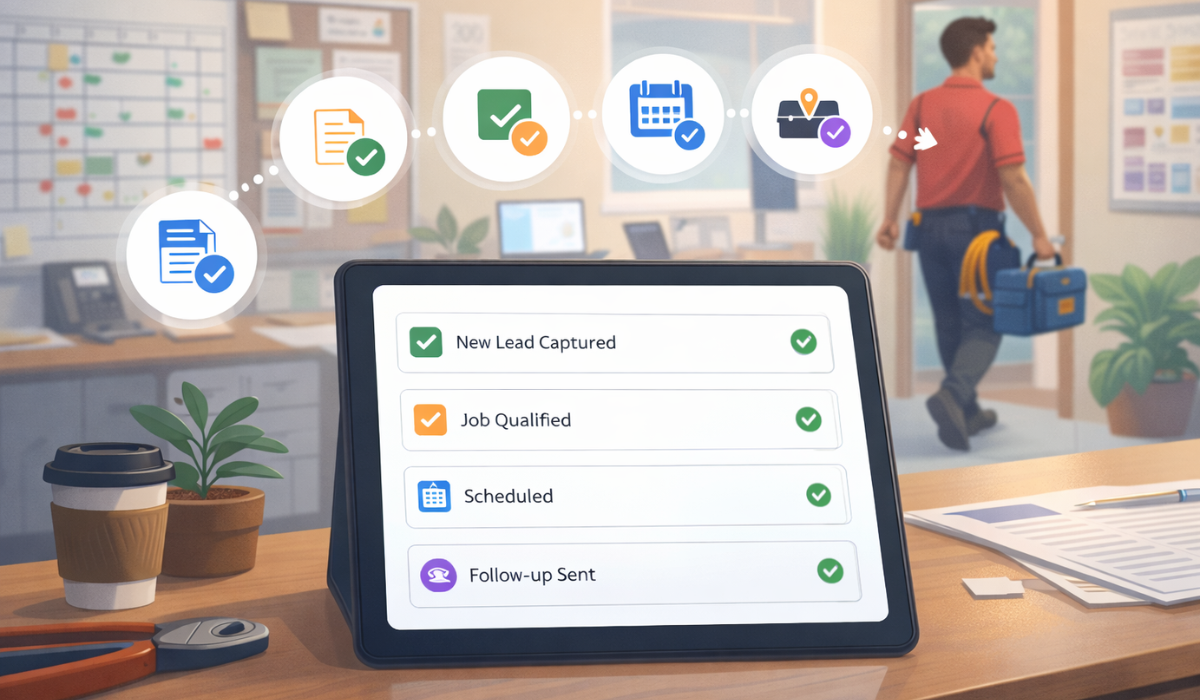
This is why the conversation around automation in home services should move beyond simple call deflection. The real opportunity is operational architecture. A conversational ai chatbot on web and messaging channels, a conversational ai voicebot on inbound calls, and structured ai booking workflows together create a coordinated intake layer that works day and night. That layer captures service details, triages urgency, routes requests, confirms next steps, and keeps records consistent before a human ever opens a ticket. When implemented correctly, it does not remove the human relationship that drives trust in local service brands. It removes friction that blocks humans from doing their best work. Industry reporting from HubSpot shows that service leaders using AI consistently report faster response times and stronger ability to scale support without linear headcount growth. Source: HubSpot Service Trends. For owners, the practical question is no longer whether AI can answer a call. The practical question is how much additional performance can be unlocked when every lead, request, and follow-up starts with clean, immediate, and standardized communication. The companies that treat this as a core operating model, not a side experiment, usually see compounding gains because each workflow improvement strengthens the next one.
How do AI agents improve revenue capture in home services?
Revenue capture improves first at the point of contact, where most hidden losses happen. Many home services businesses invest heavily to make the phone ring, yet still lose opportunities because speed to answer is inconsistent, qualification is incomplete, or scheduling stalls during busy periods. An AI receptionist service closes these gaps by responding instantly, collecting key job information in a consistent sequence, and moving qualified prospects toward confirmed next steps without delay. The effect is especially significant after hours, during lunch-time bottlenecks, and during seasonal surges when office staff is fully occupied. A home services call answering service powered by AI can classify emergencies, route urgent calls appropriately, and queue non-urgent requests with complete intake notes for morning follow-up. That means fewer high-intent leads leak out to competitors and fewer callbacks begin with confusion. Revenue capture also rises because AI can support quote follow-up, reactivation of stale estimates, and maintenance-plan reminders that many teams intend to do but rarely execute consistently. Each of those workflows increases booked work from existing demand rather than forcing additional marketing spend. Over time, higher conversion from the same lead volume becomes one of the fastest ways to expand gross margin. It also improves marketing efficiency because every dollar spent to generate inquiries produces a higher percentage of booked and completed jobs.
Why do AI agents raise labor efficiency without overloading staff?
Labor efficiency improves when the team spends less time repeating the same low-leverage tasks and more time resolving exceptions, supporting customers, and optimizing schedules. In many offices, experienced coordinators still burn hours asking the same basic questions, repeating policy answers, and manually rewriting notes from one system into another. AI agents absorb that repetitive layer through phone support automation and standardized intake logic, which protects skilled staff for work that actually benefits from judgment. The office gains capacity without immediately adding payroll, and technicians receive cleaner work orders that reduce avoidable back-and-forth. The result is not a colder operation. It is a better allocation of attention. The U.S. Department of Labor reminds employers that overtime requirements can escalate labor expense quickly when workflow inefficiencies push teams beyond standard hours. Source: U.S. Department of Labor. By reducing administrative spillover at the end of the day, AI agents help control overtime tied to communication cleanup rather than true service demand. They also lower burnout risk, which protects retention and reduces the hidden costs of rehiring and retraining. In practical terms, labor efficiency gains come from fewer interruptions, fewer duplicate steps, and fewer preventable errors per job cycle. As these gains stack up, many teams find that they can support higher job volume with less stress and better schedule discipline.
How do AI agents deliver faster response times across every channel?
Faster response is not just a customer convenience metric in home services. It is often the difference between winning and losing the job. When a homeowner is dealing with no cooling, a burst pipe, or an electrical concern, the first provider to deliver a clear and helpful response usually earns trust first. AI agents enable that speed by maintaining continuous coverage across calls, website chat, and messaging touchpoints, even when staff is unavailable. A conversational ai voicebot can answer immediately, gather critical facts, confirm service area eligibility, and trigger the right escalation path in seconds. A conversational ai chatbot can do the same on digital channels without forcing customers to wait for business hours. This speed compounds in downstream operations as well. Dispatch receives complete notes sooner, technicians can be assigned with better context, and customers receive confirmation updates faster. HubSpot and Salesforce research both emphasize that quick response and transparent communication strongly influence satisfaction and loyalty outcomes. Sources: HubSpot Service Trends and Salesforce State of the Connected Customer. For owners, the business impact is straightforward: faster first response increases conversion probability, reduces cancellation risk, and protects brand reputation during high-pressure service events. In emergency-heavy categories, shaving even a few minutes from response workflows can materially improve close rates and customer confidence.
What does better customer experience look like with AI agents?
Better customer experience in home services is built on clarity, consistency, and confidence. Customers want to know they have been heard, they want to understand what happens next, and they want communication that matches the urgency of their issue. AI agents improve this experience by making first contact predictable and informative instead of chaotic. Every interaction can follow a structured flow: acknowledge the request, gather relevant details, set clear expectations, and route to the right next step. That consistency matters because customer frustration often comes from uncertainty, not just wait time. AI can also support multilingual interactions, appointment reminders, ETA updates, and post-service check-ins that reinforce professionalism at every stage. Importantly, the strongest deployments preserve clear human handoff points for sensitive, complex, or emotionally charged cases. Customers do not need a machine to solve every problem. They need confidence that the business can respond quickly and connect them to the right person when nuance matters. This is where conversational ai for small business becomes a service-quality multiplier. Instead of replacing relationships, it protects them by preventing missed callbacks, disorganized handoffs, and repetitive friction that make even good teams look disjointed. The long-term benefit is stronger retention, stronger referral momentum, and stronger online reputation from customers who feel informed throughout the service journey.
How do AI agents create operational leverage for owners?
Operational leverage means generating more output, revenue, and customer value from each unit of time, labor, and management attention. AI agents create this leverage by turning fragmented communication work into reusable systems. Once intake logic, routing rules, escalation policies, and ai booking steps are configured, every new inquiry can flow through the same high-quality process regardless of day, channel, or seasonal demand level. Owners no longer need to personally bridge every gap in coverage, and managers spend less time on reactive coordination. This frees leadership bandwidth for higher-impact activities such as technician development, pricing strategy, service-area expansion, and partnership growth. Operational leverage also improves forecasting. With cleaner data at first touch, teams can see where demand originates, where conversion stalls, and where schedule bottlenecks form. That visibility enables better staffing decisions and better marketing allocation because decisions are based on process data rather than anecdote. As adoption grows, AI agents can extend beyond intake into review solicitation, membership renewals, and reactivation campaigns, adding revenue without linear administrative growth. This is why top-performing operators view AI as infrastructure. It creates a repeatable platform for scaling quality, not just a tool for answering more calls. The strongest operators then layer disciplined measurement on top of that infrastructure, reviewing weekly trends in answer speed, booking rate, overtime hours, and customer follow-through to keep the system improving.
How should home services companies implement AI for measurable results?
The most successful rollouts start with one high-friction workflow and one clear business outcome. For many teams, that initial focus is missed-call recovery or after-hours intake, because both are directly tied to lost revenue and overtime pressure. Define what success looks like before launch: higher booking rate from inbound opportunities, shorter first-response times, reduced admin overtime, and improved customer follow-through. Then map the exact rules the AI agent should follow, including required intake fields, urgency thresholds, service-area logic, and mandatory handoff triggers. Integration planning is critical. If AI output is not connected to existing scheduling and CRM workflows, teams can end up with extra work rather than less work. Training is equally important because staff adoption determines whether operational gains persist. Position AI as support for workload relief and service consistency, not as a threat to team value. Review performance weekly in the first ninety days and adjust scripts, routing, and escalation logic based on real interactions. This disciplined approach turns early wins into durable capability. It also ensures that gains in revenue capture, labor efficiency, response speed, and customer experience translate into long-term operational leverage rather than short-lived automation experiments.
Conclusion
Home services leaders do not need more complexity. They need more control over the moments that determine growth and profitability. AI agents provide that control by strengthening the front line where demand is won or lost: first response, qualification, scheduling, and follow-up. When those moments are handled quickly and consistently, revenue capture rises because fewer opportunities slip away. Labor efficiency improves because skilled people spend less time on repetitive intake and more time on high-value service work. Response times accelerate across channels, which boosts trust at the exact moment customers are deciding who to hire. Customer experience becomes more dependable because communication is clear, structured, and timely. Most importantly, owners gain operational leverage, meaning the business can scale output and quality without scaling chaos at the same rate. In a competitive market where staffing pressure and customer expectations continue to rise, AI agents are becoming a practical foundation for sustainable growth. The companies that adopt them thoughtfully now will be better positioned to protect margins, strengthen reputation, and out-execute competitors over the next decade. The path forward is practical: start with a clear bottleneck, implement with measurable goals, and scale only after the process proves value in real operating conditions. Businesses that adopt this discipline early often discover that AI does not only improve current performance, it improves strategic flexibility by giving leaders better data, stronger process control, and more predictable outcomes during expansion.
Ready to Build an AI-Enabled Home Services Operation?
AE Technology Solutions helps home services businesses implement AI agents that improve revenue capture, labor efficiency, faster response times, better customer experience, and operational leverage without disrupting day-to-day service delivery. We design practical systems that combine conversational ai chatbot and conversational ai voicebot workflows, structured ai booking processes, and policy-based escalation so your team gets immediate relief and measurable performance gains. Whether you run plumbing, HVAC, electrical, cleaning, or a multi-trade operation, we can map your current communication bottlenecks and deploy a phased solution tied to clear business metrics. The objective is simple: capture more of the demand you already generate, reduce labor waste hidden in repetitive coordination, and create scalable service quality your customers can feel. Our team supports strategy, implementation, integration, and ongoing optimization so your operation can keep improving long after go-live. We also provide practical adoption support for managers and office teams so daily use remains consistent and value is sustained quarter after quarter. You get a practical roadmap, clear implementation milestones, and visibility into ROI from week one through long-term scale. Visit www.aetechnologysolutions.com to schedule a strategy session and see how an AI receptionist service and a modern home services call answering service can help your company grow with confidence.
Comments