.png?width=150&height=66&name=logo_ae_tech_2-(1).png "AE Technology Solutions Logo")
.png?width=200&height=66&name=logo_ae_tech_2-(1).png "AE Technology Solutions Logo")



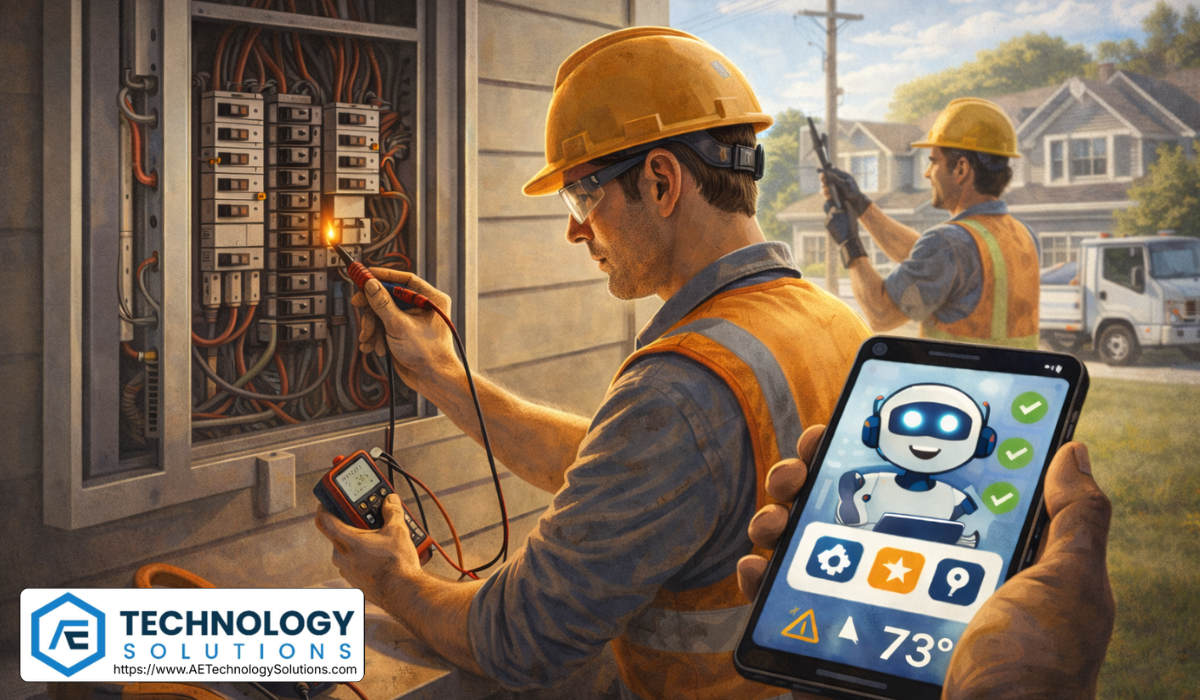
At 8:36 PM, a homeowner calls about intermittent breaker trips and a burning smell near the panel. At 10:07 PM, a restaurant manager reports partial outage in the prep area and needs same-night guidance to avoid spoilage and lost service. At 5:59 AM, a property manager calls about hallway lighting failure before tenants leave for work. These situations are not rare for electrical services. They are high-anxiety moments where response quality matters as much as response speed. In electrical operations, after-hours demand combines safety risk, urgency, and customer uncertainty, which means the first provider that responds clearly and credibly often wins the job and the long-term account. When no one answers, or when intake fails to capture critical context, the business does not only lose one call. It can lose trust, referrals, and high-margin follow-on work such as panel upgrades, rewiring, and preventive maintenance plans. This is why electrical leaders are rethinking after-hours operations as a conversion and risk-management system, not a scheduling inconvenience. The strategic question is whether human-only coverage remains the best model once total cost and lost-opportunity impact are measured honestly. In fast-moving outage scenarios, the firm that communicates clearly first usually controls both the emergency response and the follow-on project conversation.
Electrical companies already feel the strain in day-to-day operations. Office teams are asked to manage dispatch updates, estimate follow-ups, permit coordination, and urgent calls with limited after-hours staffing. On-call technicians need accurate context before they make a safety decision, yet late-night intake quality often varies by who answered and how overloaded they were. Wage pressure and overtime burden add cost uncertainty, especially during storm events and seasonal peaks. Sources: U.S. Bureau of Labor Statistics and U.S. Department of Labor Overtime Guidance. At the same time, safety expectations in electrical work remain high, with guidance from NFPA and ESFI reinforcing how quickly minor warning signs can become serious incidents if response is delayed or mis-triaged. Sources: NFPA and ESFI. Add customer behavior trends showing preference for immediate answers and clear next steps, and it becomes obvious that after-hours communication quality directly affects both revenue capture and risk exposure. Electrical firms that treat this as a measurable operating system usually outperform those that treat it as an ad hoc staffing challenge. They also reduce technician frustration because dispatch quality improves when first-contact details are collected consistently.
The shift underway in electrical services is practical and outcome-driven. Instead of asking only who can answer after-hours calls, high-performing teams ask how every inquiry can move through a consistent intake path with urgency scoring, safety prompts, and clear handoff to dispatch. A coordinated AI agent layer supports this model. A conversational ai chatbot can handle web and text intake, a conversational ai voicebot can answer inbound calls with natural dialogue, an ai receptionist service can maintain professional first response, triage logic can route safety-critical issues rapidly, and ai booking workflows can secure appointment windows and confirmations. In electrical services, this structure matters because the difference between routine service and urgent escalation is often in the details collected during the first two minutes. Clean intake improves technician readiness, protects customer confidence, and reduces avoidable repeat dispatch. Humans remain essential for nuanced risk judgment and on-site decisions, but AI agents can absorb repetitive intake load so licensed professionals focus on high-value technical work rather than administrative bottlenecks. It also gives operations leaders cleaner data for coaching, staffing, and service-level planning.
What does after-hours human coverage really cost electrical contractors?
Human-only after-hours coverage carries direct and hidden costs that frequently exceed initial estimates. Directly, firms pay for rotating coverage, backup coverage, supervisory oversight, training, and overtime when call volume spikes unexpectedly. Fully burdened labor includes wages, taxes, benefits, PTO, turnover, and management time spent correcting inconsistent notes or missed follow-up. In electrical services, hidden costs are often larger because intake errors can trigger safety risk, dispatch inefficiency, and avoidable second visits. If the first call does not document panel type, outage scope, hazard indicators, or occupancy context, technicians may arrive underprepared, which hurts response quality and increases cycle time. Morning operations are also affected when staff spend early hours requalifying incomplete overnight leads instead of moving active projects forward. During storms or heat-related utility issues, these inefficiencies multiply quickly. One missed call can mean a lost emergency visit plus lost upgrade work tied to the same account. Human coverage is still critical for complex customer conversations, but relying on people alone for every after-hours intake step is usually the highest-cost and lowest-consistency option under real operating conditions. This financial drag often remains hidden until firms begin measuring the full cost of rework, dispatch corrections, and delayed booking. Once measured, it often becomes one of the clearest opportunities for operational margin improvement.
How do AI agents change after-hours economics for electrical services?
AI agents change economics by converting fixed coverage expense into scalable response infrastructure. A modern electrician call answering service powered by conversational ai chatbot, conversational ai voicebot, and ai receptionist for electricians workflows can answer continuously, capture standardized context, and route calls by urgency at any hour. Instead of staffing for worst-case peaks every night, firms can maintain high response quality while matching cost to actual demand patterns. For electrical contractors, this is especially valuable when weather events or utility disruptions produce short but intense call surges. A properly configured ai chatbot for electricians can classify common request types, capture hazard signals, and trigger escalation to on-call technicians based on policy thresholds. Scheduling agents then support ai booking with confirmed windows, customer details, and job notes that are dispatch-ready. Owners should evaluate this model through unit metrics: cost per answered opportunity, cost per qualified urgent dispatch, and margin preserved from faster first response. When measured this way, conversational ai for small business often shows strong ROI because it improves both conversion and operational discipline. The benefit is not just fewer missed calls. It is a better alignment between intake quality, technician utilization, and customer trust. With that alignment, teams can plan labor more efficiently and reduce expensive schedule volatility. It also improves forecast confidence because operating leaders can anticipate surge behavior with cleaner intake trend data.
How much business is generally lost when electrical calls go unanswered?
Loss varies by market, but electrical categories share a consistent pattern. If urgency is high and a caller does not get a clear answer fast, they keep calling competitors. They rarely wait for next-day voicemail callbacks when safety or business interruption is involved. Research from Google and HubSpot continues to reinforce that speed and clarity heavily influence service provider selection in high-intent moments. Sources: Think with Google and HubSpot Research. A practical planning model is straightforward. Monthly after-hours opportunities x unanswered share x set-rate x close-rate x average gross profit per job equals profit at risk. Example: 310 opportunities x 34 percent unanswered x 48 percent set-rate x 38 percent close-rate x $1,250 gross profit equals roughly $961,000 annual gross profit at risk. Even with lower assumptions, annual leakage remains significant for many electrical firms. Importantly, missed after-hours electrical inquiries can reduce future account value because customers remember who responded during stressful situations. Losing one emergency often means losing the later panel replacement, EV charger install, service agreement, and referral chain that would have followed a strong first response. That chain effect is why after-hours intake quality should be managed like a growth metric, not just a support metric. Firms that treat it this way typically improve both conversion speed and long-term account retention.
Why safety triage quality matters as much as answer speed in electrical work
Electrical services differ from many trades because intake quality can directly influence safety outcomes before a technician arrives. Fast answering helps, but structured triage determines whether the right action happens next. A 24 7 electrician answering service should identify risk indicators quickly, including odor, heat, visible damage, sparking reports, or critical-load impact in medical and commercial contexts. AI agents support this by applying consistent prompts and escalation rules every time, without fatigue effects that can occur in long overnight shifts. An ai chatbot for electricians can gather site details and symptom timelines, while voice and receptionist agents keep communication calm and precise. Then scheduling and dispatch handoff logic can prioritize by risk and service-level commitments. This improves technician preparedness and can reduce unnecessary truck rolls caused by incomplete first-contact information. It also helps office teams avoid morning backlog and rework. Over time, safety-aware intake workflows strengthen both customer confidence and internal operating discipline. Firms that pair speed with triage consistency are better positioned to win urgent work and deliver reliable outcomes across residential and light commercial segments. They also reduce liability exposure by documenting intake pathways in a more consistent, auditable way. That documentation can support internal quality reviews and improve training for newer team members.
How to build an electrical break-even model your team will trust
A strong break-even model should connect finance, dispatch, and service quality in one operating view. Block one is current after-hours cost, including burdened labor, overtime, supervision, and rework. Block two is response leakage, using real call logs, response latency, and booking outcomes by call type. Block three is AI program cost, including implementation, policy setup, integrations, and monthly usage. Block four is recovered value from improved answer rate, better triage quality, and higher close conversion on urgent calls. Then test conservative, expected, and peak-event scenarios. For electrical teams, include safety-related metrics in addition to revenue metrics, such as escalation accuracy, repeat dispatch rate, and technician prep quality based on first-contact notes. Weekly scorecards should track speed-to-answer, qualified dispatch set rate, ai booking completion, and gross profit per after-hours originated job. This model keeps decisions grounded in measurable outcomes rather than technology hype. It also makes staffing conversations more productive, because teams can see where human expertise is most valuable and where automation should carry repetitive workload. When leadership can audit results clearly, adoption becomes faster and change management becomes easier. It further improves cross-team alignment because dispatch, office, and field leaders evaluate performance through the same measurable lens. With this structure, improvement plans become easier to prioritize and easier to hold accountable.
Conclusion
After-hours operations in electrical services sit at the intersection of revenue, safety, and customer trust. Human expertise is indispensable for technical judgment and field execution, but human-only intake models are expensive to sustain and hard to scale with consistency during peak events. AI agents provide a practical way to strengthen first response without overextending staff. A coordinated system that includes conversational ai chatbot, conversational ai voicebot, ai receptionist for electricians workflows, triage logic, and ai booking can improve conversion while reducing operational friction. It can also support better safety routing, cleaner dispatch handoff, and stronger customer confidence in urgent situations. For most contractors, the best path is hybrid: AI-first intake with human escalation where nuance and licensing judgment are required. The economics become clear when total labor burden is compared against recovered profit from opportunities that would otherwise be missed. In electrical markets where response reliability is a competitive differentiator, firms that systematize after-hours intake gain measurable advantage in growth, retention, and service quality. Over time, this advantage compounds into stronger recurring account value and more resilient referral pipelines. It also creates more stable operating rhythms for teams that previously relied on reactive, overtime-heavy coverage.
Ready to Transform Your Electrical After-Hours Operations?
AE Technology Solutions helps electrical contractors deploy full-scope AI agent systems that fit real dispatch and safety workflows. If your team is evaluating ai receptionist for electricians models, an electrician call answering service, 24 7 electrician answering service coverage, or broader ai booking and phone support automation, we can build a phased rollout aligned to your operating constraints. We begin with your own inquiry and dispatch data, identify leakage points, and design chat, voice, triage, and scheduling flows that support both conversion and risk-aware escalation. The result is faster response, cleaner handoffs, and more predictable after-hours performance without relying on constant overtime expansion. Visit www.aetechnologysolutions.com to schedule a strategy session and receive a practical comparison between your current model and an AI-first hybrid approach tailored to electrical services. You will leave with clear milestones, accountable metrics, and an implementation plan your team can execute immediately. We can also help establish weekly governance so improvements in response quality and booking performance are sustained over time. If preferred, rollout can start with one service region so your team can validate outcomes before full deployment. This phased model helps teams manage change confidently while still capturing measurable gains early.
Comments