.png?width=150&height=66&name=logo_ae_tech_2-(1).png "AE Technology Solutions Logo")
.png?width=200&height=66&name=logo_ae_tech_2-(1).png "AE Technology Solutions Logo")


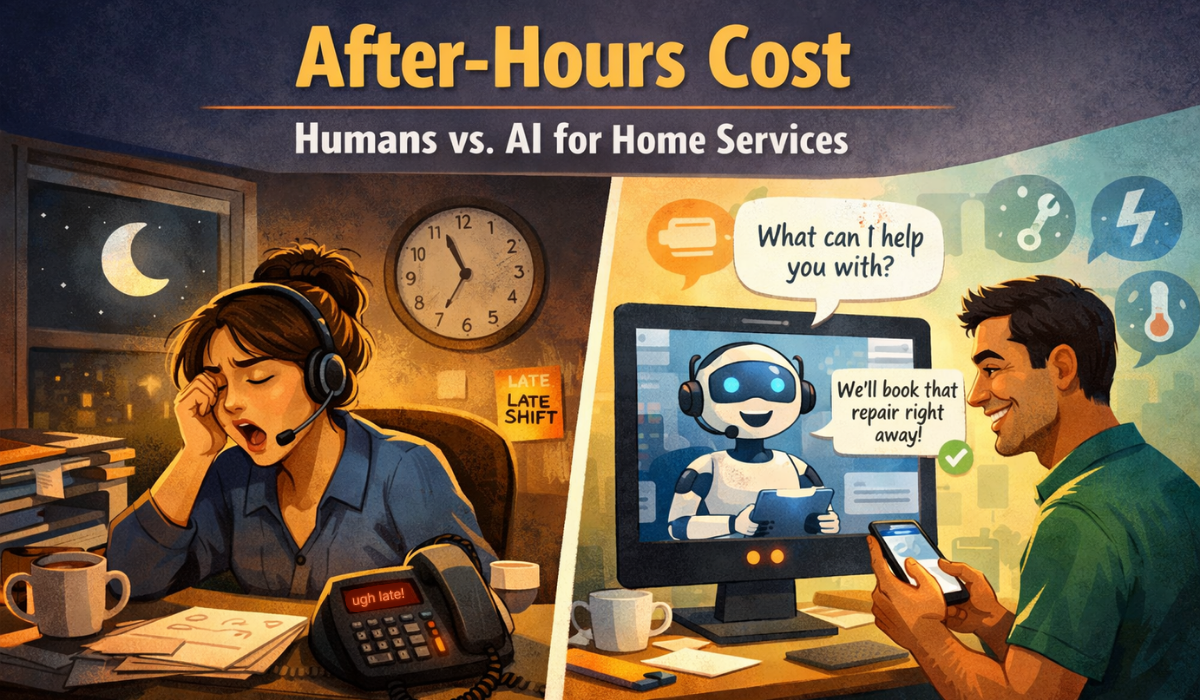
At 8:17 PM, a homeowner notices water spreading across the laundry room floor. At 9:42 PM, another family has no heat during a cold snap. At 10:03 PM, a property manager needs an emergency electrical visit before tenants wake up. None of these people care that your office closes at 5 PM. They care about speed, trust, and whether someone answers right now. In home services, after-hours demand is not a small edge case. It is where urgency, higher ticket jobs, and first-call wins collide. The hard truth is simple. If there is no reliable after-hours coverage, revenue leaks quietly every night. Some calls never come back. Some leads book with whoever answered first. Some emergencies become bad reviews because the caller felt ignored. This is why the question is no longer whether after-hours coverage matters. The real question is what model makes financial sense: traditional human coverage, an outsourced answering team, or an AI receptionist service powered by a conversational ai chatbot and conversational ai voicebot that can respond instantly across phone and web. For owners, this decision has become more urgent because customer expectations now reward the fastest credible response, not the biggest brand. The contractor who captures the full intake in under two minutes often wins the job before competitors even see a voicemail notification the next morning. In crowded metros and fast-growing suburbs, that speed gap can define which companies build repeatable growth and which ones keep replacing lost leads month after month.
Most owners already feel the pain but have not modeled it with numbers. They know payroll is rising. They know schedule gaps and no-shows drain margin. They know office staff burnout increases turnover. Yet many businesses still evaluate after-hours operations emotionally instead of financially. They compare line-item cost without calculating opportunity cost. They also underestimate how often callers choose the first business that picks up, especially in urgent categories like plumbing, HVAC, and electrical repair. According to U.S. Bureau of Labor Statistics data, wages for administrative and customer-facing roles continue to climb over time, and total labor burden rises further once payroll taxes, benefits, training, and overtime are included. Source: U.S. Bureau of Labor Statistics. Overtime rules under the U.S. Department of Labor add additional pressure when teams extend evenings and weekends. Source: U.S. Department of Labor Overtime Guidance. Add software, supervision, and rework from inconsistent call handling, and the true after-hours labor bill is often far higher than expected. It is also common to miss second-order costs such as manager interruptions, dispatcher context switching, and slower follow-up on next-day estimates because teams are cleaning up incomplete overnight notes. Companies with multiple service lines also absorb coordination drag when after-hours details are incomplete and teams spend morning dispatch windows calling customers back for missing basics. That is why a decision framework based on total cost and captured revenue is more useful than any single technology pitch.
The transition happening across home services is practical, not hype-driven. Businesses are moving from a staffing-only mindset to a coverage-and-conversion mindset. Instead of asking, 'How do we keep someone on phones all night?' they ask, 'How do we reliably answer, qualify, and book every valuable call while protecting margin?' That shift is important because after-hours performance depends on consistency more than heroics. A tired team member at 11 PM may still do a great job, but consistency drops as load, fatigue, and call complexity rise. A conversational ai chatbot and conversational ai voicebot can handle repetitive intake, triage urgency, collect job details, and trigger escalation rules every time, then route true emergencies to on-call technicians with context already captured. For many companies, the model is not human versus AI as a strict either-or decision. It is AI-first intake with human escalation where judgment or policy requires it. This hybrid approach supports ai booking and phone support automation while giving leadership better visibility into missed opportunities, response speed, and conversion trends by time of day. It also improves coaching because leaders can review interaction patterns, tighten scripts, and refine escalation thresholds using actual after-hours transcripts and call outcomes instead of relying on memory or anecdotal feedback. Over time, this creates a compounding effect where every month of interaction data makes your intake system more accurate and more profitable.
What does after-hours staffing really cost home services companies?
To compare options honestly, start with a baseline example for one location. Assume after-hours coverage from 5 PM to 8 AM on weekdays plus full weekend coverage, roughly 128 hours per week. If this is handled by internal staff, the schedule often requires multiple people to avoid burnout and legal risk. Even when one person is on duty at a time, businesses still pay for backup coverage, management overhead, and quality control. Suppose the fully loaded hourly cost for a trained coordinator is between $28 and $42 once benefits, taxes, paid time off, training, and turnover are included. Annualized, that range can reach roughly $186,000 to $280,000 for continuous coverage, before considering overtime spikes, sick-day gaps, and seasonal volume. If coverage is split across office staff, hidden cost appears as daytime productivity loss, slower dispatch operations, and avoidable errors. These are real costs even if they do not appear in one payroll line. External answering services can reduce direct payroll, but quality and booking depth vary widely by script design, integration level, and industry familiarity. Another frequent blind spot is variance: service quality may depend heavily on which person is working, which creates uneven booking outcomes across nights and weekends. You should also price in time spent auditing calls, fixing calendar conflicts, and handling duplicate tickets that originate from rushed overnight handoffs. In short, the human model can work, but it is usually more expensive and less consistent than owners expect once all burdened costs are included.
How much does an ai receptionist service cost after hours?
AI economics look different because cost is tied to platform capacity, conversation volume, and integration scope rather than shift scheduling. In many real deployments, a conversational ai voicebot and conversational ai chatbot stack can deliver 24/7 first-response coverage at a fraction of full internal staffing cost, especially for repetitive intake and routing. Common cost structures include a base platform fee plus usage, or a bundled monthly subscription that includes ai booking workflows, integrations, and reporting. For a small to mid-sized home services business, a practical all-in range can be around a few hundred to a few thousand dollars per month depending on volume, channels, and escalation complexity. The right way to compare this to humans is not only monthly spend. Compare effective cost per answered lead, cost per booked job, and cost per recovered emergency opportunity. AI also avoids overtime premiums and can scale instantly during weather events or weekend spikes without adding headcount. This is where conversational ai for small business becomes financially compelling. You move from fixed labor blocks to flexible capacity while maintaining immediate response coverage and standardized qualification logic across every after-hours interaction. Over a full year, that flexibility can make budgeting more predictable because spend aligns with actual demand rather than worst-case staffing assumptions. It also makes expansion easier because new service areas can launch with the same after-hours quality standard instead of waiting to recruit and train additional night staff, while ai booking rules remain consistent across teams.
How much business is generally lost when no one answers after hours?
The exact number varies by trade and market, but the pattern is consistent. When urgent callers cannot reach a live responder, a meaningful share does not wait. They call the next provider, submit a form elsewhere, or postpone until the problem gets worse and trust is already broken. Consumer behavior research from Google and customer service trend reporting from HubSpot consistently points to the same operating reality: response speed strongly influences provider choice, especially for high-intent service interactions. Sources: Think with Google and HubSpot Research. For planning, use a conservative loss model instead of guessing one universal percentage. Start with monthly after-hours inbound opportunities. Multiply by your estimated answer gap rate, then by average close rate, then by average gross profit per job. Example: 320 after-hours opportunities per month x 35 percent not handled x 45 percent close rate x $420 gross profit equals about $21,168 in monthly gross profit at risk. Even if you halve those assumptions to stay conservative, the annual impact can still be large. You should also account for delayed-loss effects, where a poor first contact reduces future maintenance plan sign-ups, referral activity, and review sentiment. In emergency-heavy markets, losing the first call can also remove your chance to win high-margin follow-on work such as replacements or annual service agreements. This is why businesses with no coverage often feel busy but still miss growth targets. The loss is distributed across many small missed moments, not one dramatic failure.
Which after-hours model wins for plumbers, HVAC, electricians, and cleaning companies?
In practice, winning models are industry-tuned. An ai receptionist for plumbers should quickly separate true emergencies from routine requests, collect leak location and shutoff status, then route urgent jobs to the on-call technician with full notes. For HVAC, an ai chatbot for hvac can prioritize no-heat or no-cooling calls, capture equipment age, and pre-qualify replacement opportunities before dispatch. Electricians benefit from safety-first triage and escalation paths, which is why an ai receptionist for electricians can reduce risk while improving speed. Cleaning companies often need off-hour quote intake and schedule coordination, where ai booking workflows reduce back-and-forth and improve fill rate. In mixed-service businesses, teams may run an ai receptionist for plumbers for leak and flood triage, an ai receptionist for electricians for urgent safety workflows, and an ai chatbot for hvac for no-heat and no-cooling screening during seasonal spikes. Many owners standardize escalation by pairing an ai receptionist for plumbers with on-call dispatch rules while configuring an ai receptionist for electricians and an ai chatbot for hvac with trade-specific qualification prompts. Human teams remain critical for complex judgment and exceptions, but AI handles high-volume front-end intake reliably, giving teams cleaner handoffs and fewer incomplete call notes. The result is a hybrid operation that improves conversion and protects labor margin across major home service categories.
How do you calculate your own break-even point in 15 minutes?
Use a simple worksheet with four blocks. First, estimate current after-hours labor cost: wages, overtime, manager oversight, recruiting, onboarding, and rework from missed details. Second, estimate opportunity leakage using the conservative formula from earlier. Third, estimate AI program cost including setup, integrations, escalation design, and monthly usage. Fourth, model expected recovery. Even recovering 20 percent to 35 percent of currently missed after-hours opportunities can offset a large share of platform cost. Then stress-test with three scenarios: conservative, expected, and high-demand season. Keep assumptions visible so your team can challenge them with real call logs. If your current process already performs well, the model will show it. If not, it will show where margin is escaping. This method also avoids overpromising. You are not betting on perfect automation. You are deciding whether immediate, always-on intake and qualification improves unit economics versus staffing-only coverage. For many owners, the answer becomes clear once they compare recovered gross profit and saved labor pressure in one shared dashboard rather than debating tools in isolation. Revisit the worksheet every quarter so pricing, close rates, and seasonal patterns stay current and your decision remains grounded in current performance data. When teams align on one shared model, adoption gets easier because everyone can see exactly what success looks like.
Conclusion
After-hours operations are one of the most underestimated profit levers in home services. Human coverage can deliver strong service, but it becomes expensive and hard to scale when nights, weekends, and seasonal spikes are included. AI does not replace the value of your people. It protects their time by handling repetitive intake, speeding qualification, and ensuring urgent callers are routed correctly without delay. The most practical strategy is usually hybrid: AI-first response for consistency and speed, human escalation for complex judgment. When you evaluate total burdened labor cost against recovered revenue from calls that would otherwise be missed, the economics are often decisive. Home services leaders who treat after-hours coverage as a measurable revenue system, not a staffing afterthought, usually gain faster response times, better booking performance, and stronger customer trust. In a market where the first credible response often wins, reliable after-hours coverage is no longer optional. It is operational strategy. The companies that implement this intentionally tend to improve both top-line growth and employee sustainability at the same time. Better after-hours systems also reduce internal firefighting, giving teams more energy to focus on service quality, technician support, and profitable daytime work.
Ready to Transform Your Home Services Business?
AE Technology Solutions helps home services companies implement practical, conversion-focused after-hours systems using conversational ai chatbot and conversational ai voicebot technology designed for real field operations. Whether you need AI-first intake, escalation workflows, ai booking, or complete phone support automation across plumbers, HVAC, electricians, and cleaning teams, we can build a right-sized rollout that fits your current tools and staffing model. Book a strategy session today at www.aetechnologysolutions.com to get a clear cost comparison and a realistic recovery forecast using your own call data. We will map your current after-hours process, identify where revenue is leaking, and design an implementation plan that protects service quality while improving margin. You will leave with a clear rollout sequence, measurable targets, and a practical roadmap your team can execute without disrupting daily operations. We can also prioritize a pilot scope so you can validate conversion lift and labor savings quickly before scaling across all service lines and locations.
Comments